
TL;DR
Quality leather reveals itself through its grain pattern, smell, aging behavior, and construction details. Full-grain leather sits at the top of the quality spectrum, lasting 20 to 40+ years and developing a rich patina over time. The label “genuine leather” sounds premium but actually signals one of the lowest grades. Your best tools for spotting quality are your five senses, a basic understanding of leather grades and tanning methods, and a willingness to inspect the craftsmanship behind the product.
Why Leather Jargon Exists to Confuse You
The leather industry has a language problem. Terms like “genuine leather,” “top-grain,” and “full-grain” get thrown around on product labels and marketing pages as if they all mean the same thing: good leather. They don’t.
Here’s something most leather buying guides won’t tell you: there is no globally standardized leather grading system. Unlike diamonds, which have the GIA, or gold, which has karat certification, leather grades are industry conventions rather than regulated categories. A widely shared analysis from North Star Leather explicitly calls the common four-tier leather hierarchy “a myth” used by marketers, noting it appears on fashion blogs and in one of the most repeated Reddit TIL posts of all time. The post debunks the idea that any formal authority created or regulates these tiers.
That doesn’t make the hierarchy useless. It still reflects real, measurable differences in durability, appearance, and aging. But knowing it’s a convention rather than a law helps you approach leather labels with the right amount of skepticism.
This glossary covers every term you’re likely to encounter when shopping for leather goods, from phone cases to wallets to watch bands. Each entry explains what the term means, why it matters, and how to use it to separate quality from marketing.
Leather Grades, From Best to Worst
The most practical framework for understanding leather quality is the grade hierarchy. Think of it as a spectrum, not a rigid ranking. Each grade tells you something about how much of the original hide was preserved, and that directly determines how the leather will look, feel, and age.
Full-Grain Leather
What it means: Full-grain leather comes from the outermost layer of the animal hide and retains its complete, natural grain pattern. It has not been sanded, buffed, or corrected in any way.
Why it matters: This is the gold standard. Because the grain surface is intact, full-grain leather is the strongest, most breathable, and most durable type available. It develops a patina over time, meaning it actually looks better the longer you use it.
Key numbers: Full-grain leather has a lifespan of 20 to 40+ years with proper care. Only about 10% of hides remain pristine enough to qualify as full-grain, since any scars, insect bites, or blemishes disqualify the surface from being used without correction.
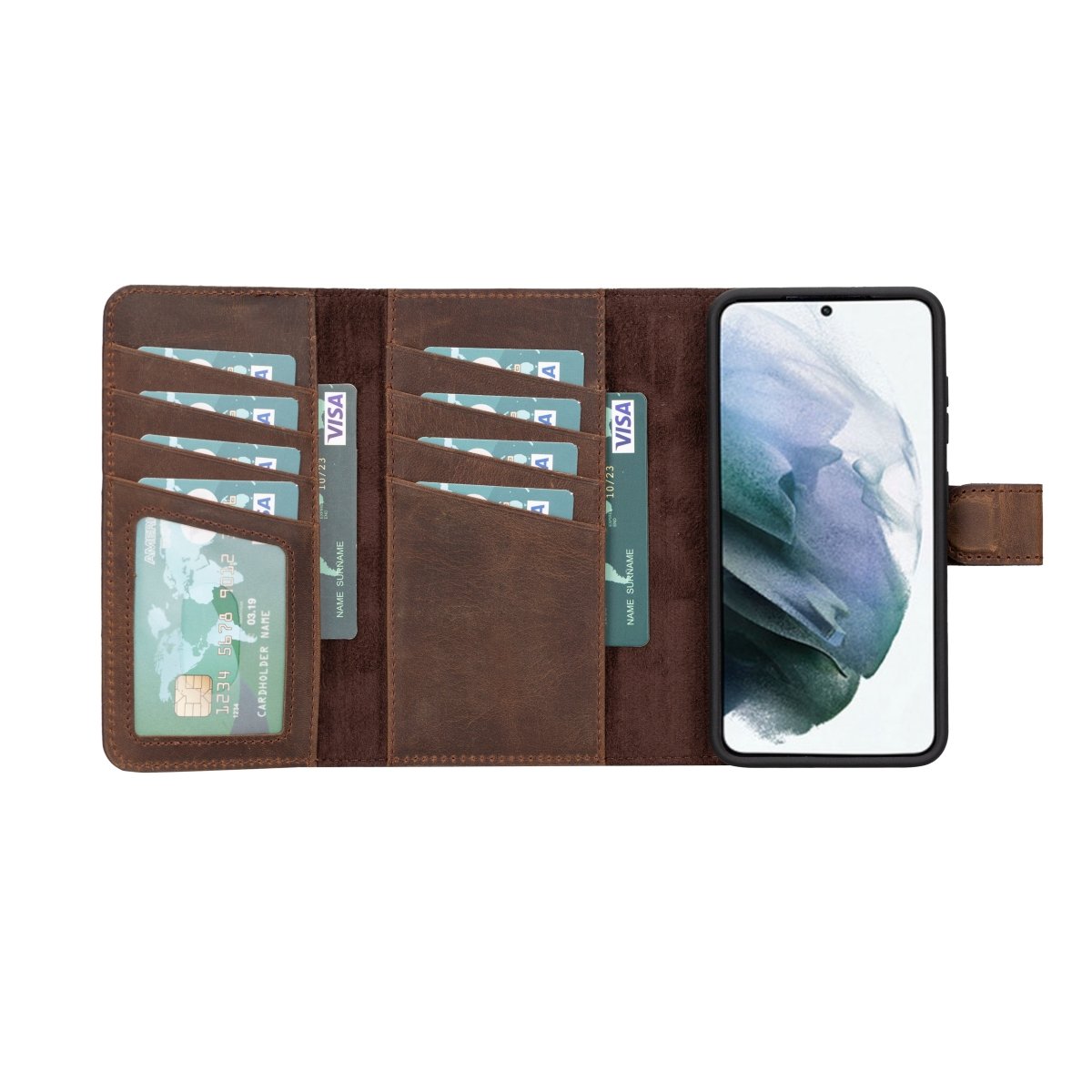
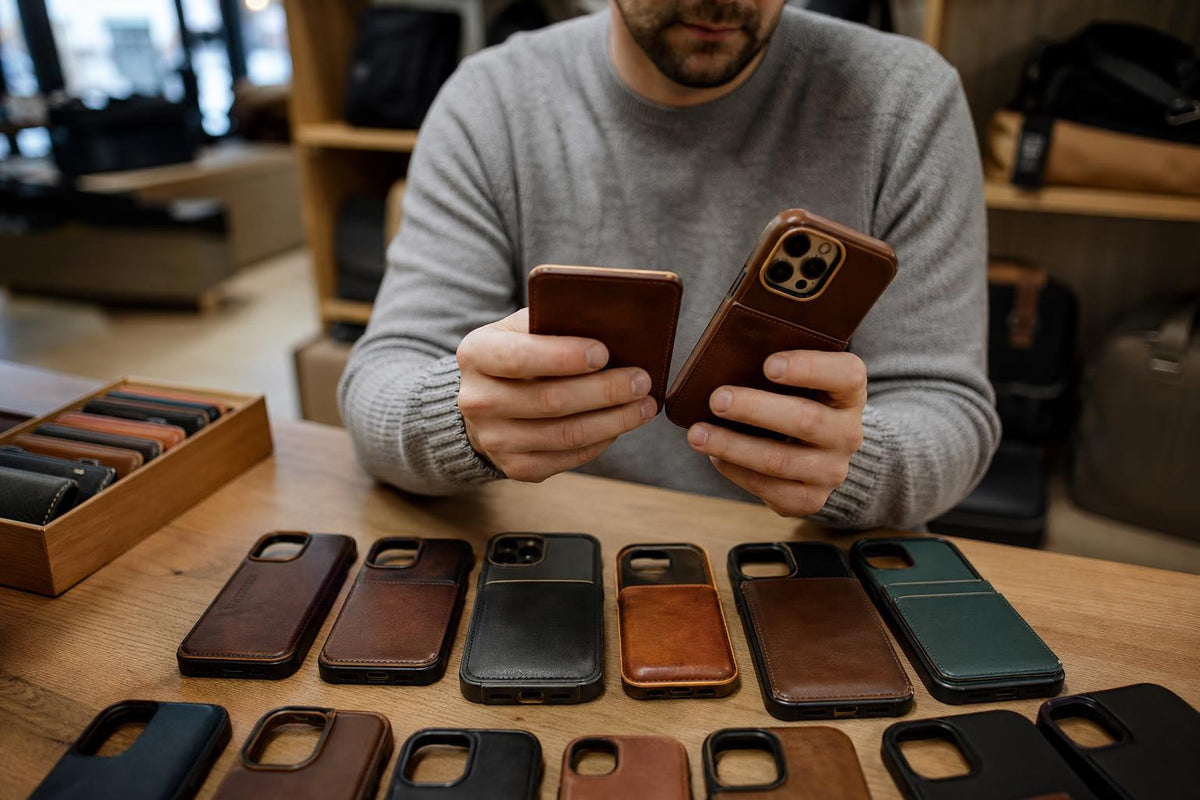
That rarity is exactly why full-grain leather commands a premium. When a brand uses it, they’re working with a small fraction of available material. Bayelon’s top leather iPhone cases and Samsung leather cases are built with 100% full-grain leather, which is worth noting because many competitors at similar price points quietly use corrected or top-grain leather instead.
Top-Grain Leather
What it means: Top-grain leather is the second-highest grade. The outermost layer has been lightly sanded or buffed to remove imperfections, then typically coated with a finish for a smoother, more uniform appearance.
Why it matters: Top-grain is still high-quality leather. It’s more stain-resistant than full-grain and looks more consistent out of the box. The trade-off? That surface coating limits how much oil the leather absorbs over time, which means top-grain leather does not develop the same depth of patina as full-grain.
Lifespan: 10 to 20 years, depending on care and thickness.
For products where uniformity matters more than character (think corporate briefcases or office furniture), top-grain is a solid choice. Just know you’re trading aging potential for consistency.
Genuine Leather
What it means: Despite the name, “genuine leather” is not a quality endorsement. It typically refers to leather made from the lower layers of the hide after the top-grain has been separated. It may also include heavily corrected or processed hides.
Why it matters: This is the single most important thing to understand when learning how to spot quality leather. The word “genuine” sounds like it means premium, authentic, the real deal. In the leather industry, it signals the opposite. It’s the marketing paradox that catches more buyers than any other label.
Lifespan: Two to five years. Genuine leather does not develop a patina. It cracks, peels, and deteriorates rather than aging gracefully.
The rule of thumb: If a product label says “genuine leather” with no further specification (no mention of full-grain, no detail about tanning), that’s your first red flag. Quality leather is worth talking about. Brands that use good leather tell you exactly what it is.
Bonded Leather
What it means: Bonded leather is made from leather scraps and fibers glued together with polyurethane or latex, then pressed onto a backing material. It contains some leather content (often 10 to 20%), but calling it leather is generous.
Why it matters: Bonded leather fails by peeling, cracking, and delaminating. It does not age. It disintegrates. You’ll find it in budget furniture and ultra-cheap accessories. Avoid it for anything you plan to use regularly.
Lifespan: Less than two years in most cases.
Split Leather and Suede
What it means: Split leather comes from the inner layers of the hide after the top grain has been separated. Suede is the most common form, valued for its soft, napped texture.
Why it matters: Suede has legitimate uses in fashion and certain accessories, but it’s less durable and more vulnerable to water and stains than full-grain or top-grain leather. It’s not inherently bad, just a different material with different limitations.
Leather Grade Comparison Table
| Grade | Source Layer | Patina | Lifespan | Best For |
|---|---|---|---|---|
| Full-Grain | Outermost (intact) | Rich, deepening | 20-40+ years | Everyday carry, heirloom pieces |
| Top-Grain | Outermost (sanded) | Limited | 10-20 years | Uniform-look products |
| Genuine | Lower layers | None | 2-5 years | Budget items only |
| Bonded | Scraps + adhesive | None | Under 2 years | Avoid |
| Split/Suede | Inner layers | Minimal | 3-8 years | Fashion, linings |
Tanning Methods and What They Mean for Quality
Most guides about how to spot quality leather focus entirely on grades and skip tanning. That’s a mistake. The tanning process determines how leather ages, feels, smells, and performs over its entire lifespan. Two pieces of full-grain leather tanned differently will behave like completely different materials.
Vegetable-Tanned Leather
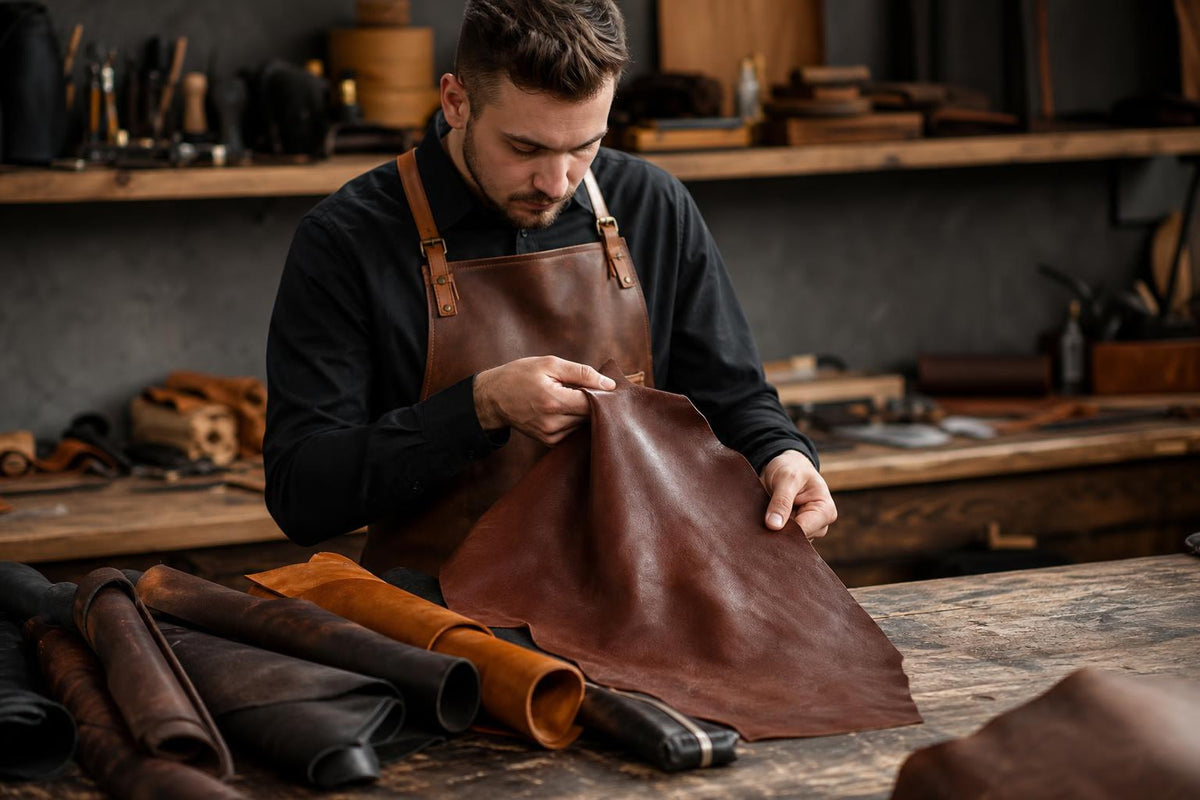
What it means: Vegetable tanning uses natural tannins derived from tree bark, leaves, and other plant materials. The process takes weeks, sometimes months, and produces leather with a firmer initial feel that softens beautifully over time.
Why it matters: Vegetable-tanned leather develops a rich, deep patina because it has no synthetic coatings blocking oil absorption. It’s the preferred choice for leather enthusiasts who want their products to age into something unique.
Trade-off: It’s more expensive due to the longer processing time, and it starts stiffer than chrome-tanned alternatives.
Chrome-Tanned Leather
What it means: Chrome tanning uses chromium salts to process hides. It can be completed in about a day, producing softer, more pliable leather with consistent color.
Why it matters: About 90% of the world’s leather is chrome-tanned. It’s the default, not the exception. Chrome-tanned leather doesn’t fade or develop a patina the same way, making it well-suited to fashion items where color consistency matters more than character.
A note on the veg-tan vs. chrome debate: Practitioners on leather forums and enthusiast sites like the Gentleman’s Gazette point out that many people now assume vegetable-tanned leather is always superior and chrome-tanned is always inferior. That’s an oversimplification. Chrome tanning produces excellent leather for specific applications. The question isn’t which is “better” but which is right for how you’ll use the product.
If you want a leather wallet or phone case that develops character over years of daily use, vegetable-tanned full-grain is the ideal. If you want a soft, colorful fashion accessory that looks the same in year three as day one, quality chrome-tanned leather serves that purpose well.
Combination Tanning
Some tanneries use hybrid approaches, starting with chrome and finishing with vegetable tannins (or vice versa). This can combine the softness of chrome tanning with some of the patina potential of vegetable tanning. It’s less common but worth knowing about if you see it mentioned on a product page.
Taking care of your leather based on its tanning method matters just as much as choosing the right grade. Our leather care and conditioning guide covers how to maintain different leather types so they age well.
Finish Types: What’s on the Surface
The finish applied to leather after tanning affects its appearance, durability, and how natural it looks. Knowing these terms helps you decode product descriptions and identify what you’re actually buying.
Aniline Leather
What it means: Aniline leather is dyed with transparent aniline dyes and has no protective surface coating. The natural grain, marks, and variations of the hide remain fully visible.
Why it matters: This is the most natural-looking finish. You’ll see everything: the texture, the pores, even minor imperfections. That’s the point. Aniline-finished leather feels warm to the touch and develops patina beautifully. The downside is that it stains more easily and requires more careful maintenance.
Semi-Aniline Leather
What it means: Semi-aniline leather gets the same transparent dye treatment as aniline, plus a thin protective topcoat. The natural grain still shows through, but the surface has slightly more resistance to stains and fading.
Why it matters: It’s the middle ground. You get most of the natural character of aniline leather with a bit more practical durability. Many high-quality leather goods use semi-aniline finishes for this reason.
Pigmented (Corrected Grain) Leather
What it means: Pigmented leather has a heavy surface coating of pigment that sits on top of the leather, hiding the natural grain underneath. The surface is often embossed with an artificial grain pattern to create a uniform look.
Why it matters: This finish is common on lower-grade leathers where the natural surface isn’t attractive enough to display. The leather underneath might be perfectly functional, but the heavy pigment gives it what experienced leatherworkers describe as a “dead” look. Every cheap leather bag you’ve seen likely uses heavy pigments with an embossed grain.
Pull-Up Leather
What it means: Pull-up leather is treated with oils or waxes that create a visible color shift when the leather is flexed, stretched, or scratched. Pull the surface taut and lighter tones appear; release it and the color evens back out.
Why it matters: It’s a sign of quality finishing, and the effect creates a lived-in look from day one. Pull-up leather is popular in boots, bags, and premium accessories. Light scratches can often be rubbed out with your thumb because the oils redistribute.
The Five-Sense Quality Test: A Quick Reference
You don’t need a lab to spot quality leather. These five tests work in a store, at a flea market, or when a package arrives at your door. They’re the most reliable methods for how to spot quality leather in real-world conditions.
The Touch Test
What to do: Press your thumb into the leather and drag it slightly. Quality leather wrinkles naturally under pressure and springs back, similar to how skin behaves. It should feel supple but substantial, not rubbery or plasticky.
What it tells you: Genuine (as in real) animal leather has a unique elasticity you won’t find in synthetic alternatives. Fake leather feels stiff, overly smooth, or unnaturally uniform to the touch. If it feels like touching a plastic tablecloth, it’s not quality leather.
The Smell Test
What to do: Hold the leather close and inhale. Quality leather has a distinct aroma often described as earthy, woodsy, or oaky. Faux leather smells like plastic or chemicals.
What to know: An interesting insight from Mission Mercantile is that the “classic leather smell” isn’t actually natural to raw hides. It comes from the combination of oils, waxes, and tanning agents used during processing. So a pleasant leather aroma is really a sign of proper tanning, not just “realness.” Chemical or acrid smells, on the other hand, point to rushed processing or synthetic materials.
The Bend Test
What to do: Gently bend or fold the leather. Watch the surface at the fold point.
What it tells you: Real leather curves easily, wrinkles naturally at the bend, and changes color slightly where it’s folded (especially pull-up leathers). The wrinkle pattern will be irregular, like the lines on your knuckles. Faux leather bends stiffly and either cracks or shows no natural variation at the fold.
This is an easy test to perform on something like a full-grain leather Apple Watch band, where you can flex the material and immediately see how it responds.
The Water Test
What to do: Place a small drop of water on the leather surface. Wait.
What it tells you: Real leather absorbs water within a few seconds, and you’ll see a slight darkening where the drop sat. Faux leather repels water entirely; it just sits on the surface in a bead.
Important nuance: Practitioners on Tannery Talk note that some high-quality real leathers have a protective wax or top finish that causes water to bead initially. The key is patience. Wait a full minute. On real leather, that bead will eventually break down and start darkening the surface. On synthetic leather, it will sit there unchanged no matter how long you wait.
The Edge Test
What to do: Look at the edges of the leather, particularly any cut edges that haven’t been finished.
What it tells you: Quality leather has raw, fibrous edges where you can see the individual fibers of the hide, like looking at the cross-section of cardboard. Synthetic leather has smooth, sealed edges, often revealing fabric or foam layers sandwiched together. If the edge looks like a layer cake of different materials, it’s not solid leather.
Craftsmanship Tells: Quality Beyond the Hide
A piece of full-grain leather can still end up in a poorly made product. Knowing how to spot quality leather means looking beyond the material itself to how it’s been assembled. These construction details separate artisan goods from mass-produced knockoffs.
Stitching Quality
What to look for: Examine the stitches closely. Quality leatherwork shows straight, consistent rows of thick, sturdy thread. The stitches should be evenly spaced with no loose ends, skipped holes, or wobbly lines.
What it tells you: Hand-stitching (particularly saddle stitching, where two needles pass through the same holes in opposite directions) is the gold standard. If one thread breaks, the other holds. Machine stitching on quality goods should still be tight and consistent. Wobbly stitching, thin thread, or visible glue around the seams signals careless production.
Brands that believe in their construction back it up. Bayelon, for instance, offers a 90-day manufacturer’s warranty covering material and craftsmanship defects, which is the kind of guarantee you don’t see from brands cutting corners.
Edge Finishing
What to look for: Quality leatherworkers bevel the edges at 45-degree angles on both sides so the edge is rounded, or “bullnosed.” This creates a smooth, tactile edge that feels intentional. Many artisans then burnish the edge (rubbing it with friction and wax until it’s glossy and sealed).
What it tells you: Thick, goopy painted edges are a sign of cost-cutting. The paint is hiding a rough or layered cross-section underneath. Properly beveled and burnished edges take time and skill. They’re one of the clearest indicators that someone cared about the finished product, not just the raw material.
Hardware Quality
What to look for: Buckles, clasps, rivets, snaps, and zippers should feel solid and heavy. Top-tier leather goods use solid brass or steel hardware.
What it tells you: Lightweight, hollow metal that flexes under finger pressure, or hardware with visible seams where two halves were pressed together, signals cheap construction. Quality hardware won’t tarnish, corrode, or break under normal use. It should feel like it belongs with the leather, not like it was an afterthought.
Dye Penetration
What to look for: If you can see a cross-section of the leather (at an edge or cut), check whether the color goes all the way through or just sits on the surface.
What it tells you: Through-dyed leather maintains its color even when scratched or worn. Surface-only dye means scratches will reveal a lighter (or completely different) color underneath. For items that will see heavy daily use, through-dyed is far superior.
Patina: The Living Proof of Quality Leather
What Patina Is
Patina is the gradual change in leather’s color, sheen, and texture that develops through use over time. It’s caused by exposure to body oils, sunlight, friction, and moisture. Rather than deteriorating, leather with patina becomes richer, darker, and more individual.
Why Patina Matters
A developing patina is one of the most reliable signs that you’re dealing with quality leather. It means the surface is alive, absorbing and responding to its environment rather than just sitting under a layer of plastic coating.
Only the two highest grades of leather, full-grain and (to a lesser extent) top-grain, will form a patina. Full-grain develops the most pronounced version because its intact surface absorbs oils freely. Top-grain develops a subtler patina because its surface coating partially blocks absorption.
Genuine leather and bonded leather don’t patina. They crack, flake, and chip. The difference between patina and peeling is, in many ways, the difference between quality leather and everything else.
Patina in Practice
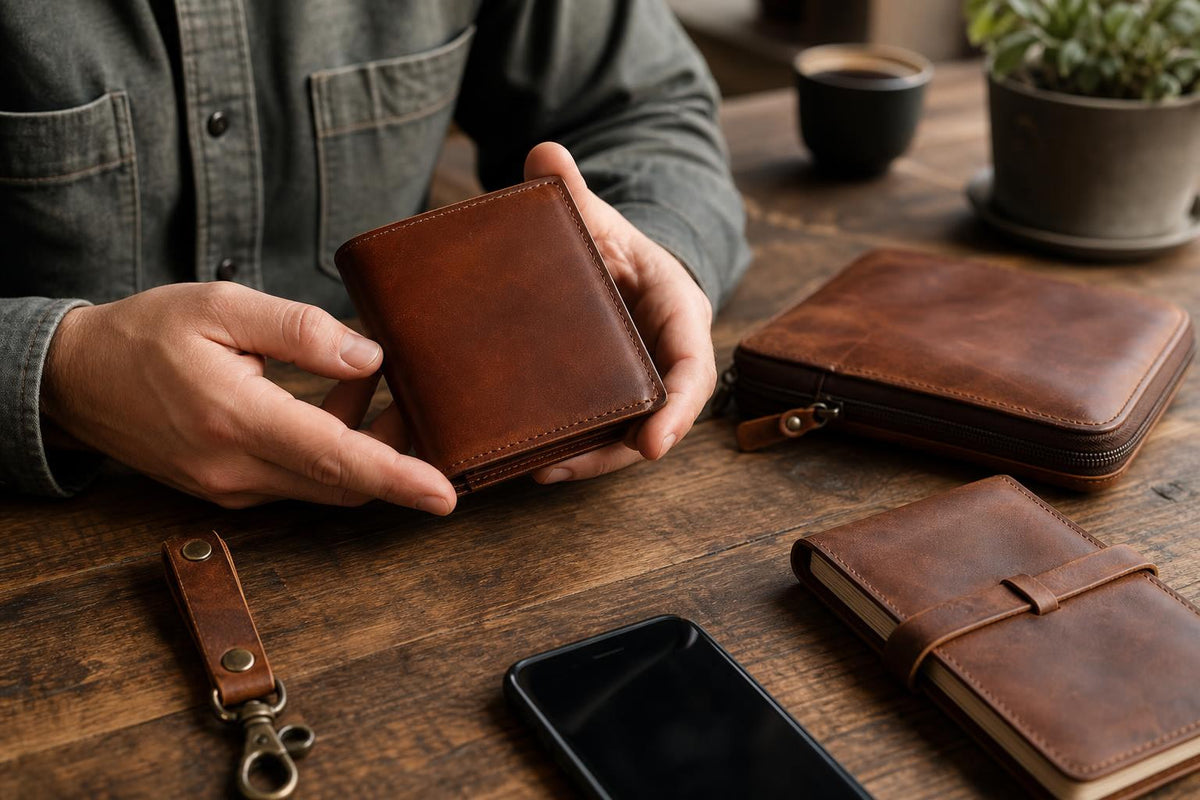
A full-grain leather wallet that you carry in your pocket every day will look noticeably different in six months: darker in the areas that contact your body, shinier where it’s rubbed against fabric, developing character lines where it folds. In two years, it will look like something entirely your own. In five years, it’s an heirloom.
That transformation is the whole point of investing in quality leather. You’re not buying a finished product. You’re buying the starting point of something that improves.
Red Flags: Signs You’re Looking at Low-Quality Leather
Spotting quality is half the equation. The other half is knowing when to walk away. These warning signs should make you think twice before buying.
“Too perfect” grain pattern. Real leather has natural irregularities, like skin. If the grain looks perfectly uniform and repeating, it’s likely machine-embossed onto a lower-grade hide (or a synthetic material entirely).
Chemical or plastic smell. Quality leather smells like nature. Budget leather or faux leather smells like a factory.
Price that seems too good. Full-grain leather goods cost what they cost because the material is scarce and the craftsmanship takes time. If a “full-grain leather bag” costs $30, something doesn’t add up.
No leather specification on the brand’s website. This is a major tell. If the company doesn’t specify the type of leather, the tanning method, or the grade, they’re probably hoping you won’t ask. Quality leather is worth talking about, and brands that use it tell you exactly what it is. Check our about page as an example of transparency in leather sourcing.
Color transfer when wet. Steer clear of leather that leaves color on your hands when it gets damp. This points to rushed tanning and poor dye fixation.
Painted edges hiding foam or fabric layers. Flip the product over. Look at any exposed edges. If you see layers of foam, fabric, or adhesive underneath a coat of edge paint, the “leather” is a veneer.
Label says only “genuine leather.” Without any further detail about grade, tanning, or origin, this label is doing the minimum required to technically not lie. That should tell you everything.
The Global Leather Market: Some Context
Understanding the scale of the leather industry puts quality questions in perspective. The global leather goods market was valued at approximately USD 266.82 billion in 2024 and is projected to reach USD 538.23 billion by 2033. In the U.S. alone, the market is expected to reach USD 220.08 billion by 2032.
With that much money moving through the industry, the incentive to pass off lower-quality leather as premium is enormous. Organizations like the Leather Working Group (LWG), which audits over 1,000 tanneries globally for environmental compliance, provide some oversight. But the responsibility for quality verification still falls largely on the buyer.
That’s why knowing how to spot quality leather isn’t just a nice skill. It’s a practical defense against an industry where marketing often outpaces substance.
One more comparison worth noting: vegan leather alternatives (typically PU or PVC based) tend to crack and peel within 2 to 5 years, putting them on par with genuine leather in terms of lifespan and far behind full-grain leather. The “sustainable” pitch of synthetic alternatives often ignores that you’ll need to replace them several times within the lifespan of a single full-grain product.
Frequently Asked Questions
Is “genuine leather” the same as “real leather”?
Technically, genuine leather is real leather, meaning it comes from an animal hide. But in industry terms, “genuine leather” refers to one of the lowest quality grades. It’s made from the lower layers of the hide or from heavily processed material. It will last 2 to 5 years at best and won’t develop a patina. The term is accurate but misleading by design.
How can I tell the difference between real leather and faux leather quickly?
The fastest method is the smell and touch combination. Real leather has an earthy, slightly musky scent, while faux leather smells like plastic or chemicals. Real leather also feels warm to the touch and develops wrinkles when pressed, while faux leather feels cold, smooth, and stiff. If you can access an edge, look for fibrous texture (real) versus smooth layers (fake).
Does the tanning method affect leather quality?
Significantly. Vegetable-tanned leather develops the richest patina and tends to be more durable long-term, but it starts stiffer and costs more. Chrome-tanned leather (about 90% of the global supply) is softer and more uniformly colored, but it won’t develop the same depth of patina. Neither method is categorically better. The right choice depends on whether you prioritize aging character or consistent softness.
How long does full-grain leather actually last?
With proper care, full-grain leather products can last 20 to 40+ years. Some leather goods (particularly well-maintained bags and belts) last even longer. The key factors are the quality of the tanning, the thickness of the hide, and whether the owner conditions the leather periodically to prevent it from drying out.
What’s the best way to test leather quality in a store?
Run through the five-sense test: touch it (should feel supple, not plasticky), smell it (earthy, not chemical), bend it (should wrinkle naturally and shift color), check the edges (fibrous, not layered), and if possible, apply a small water drop (should absorb, not bead permanently). Also inspect the stitching, hardware, and edge finishing for craftsmanship quality.
Why do some quality leather products still repel water?
Many high-quality leathers have a protective wax or top finish applied after tanning. This can cause water to bead initially, mimicking faux leather behavior. The difference is time. On real leather, a water droplet will begin to break down and darken the surface within about a minute. On faux leather, it will sit unchanged indefinitely.
Is expensive leather always better leather?
Not necessarily, but price is a useful signal. Full-grain leather is inherently more expensive because only about 10% of hides qualify, and vegetable tanning takes weeks instead of hours. If a product claims to be full-grain but costs dramatically less than comparable items from other brands, something is off. That said, a high price alone doesn’t guarantee quality. Always verify with the physical tests and craftsmanship indicators described above.
What should I look for on a brand’s website before buying leather goods?
Look for specific information about the leather grade (full-grain, top-grain), the tanning method (vegetable or chrome), and the origin of the leather. Brands confident in their materials spell this out clearly. Also look for a warranty or guarantee that covers craftsmanship defects, detailed product photography showing edges and stitching, and clear return policies. If the website is vague about what “leather” means, treat that as your first warning sign. For reference, you can browse Bayelon’s full product collection to see how leather specifications should be presented.

Leave a comment
This site is protected by hCaptcha and the hCaptcha Privacy Policy and Terms of Service apply.