
TLDR
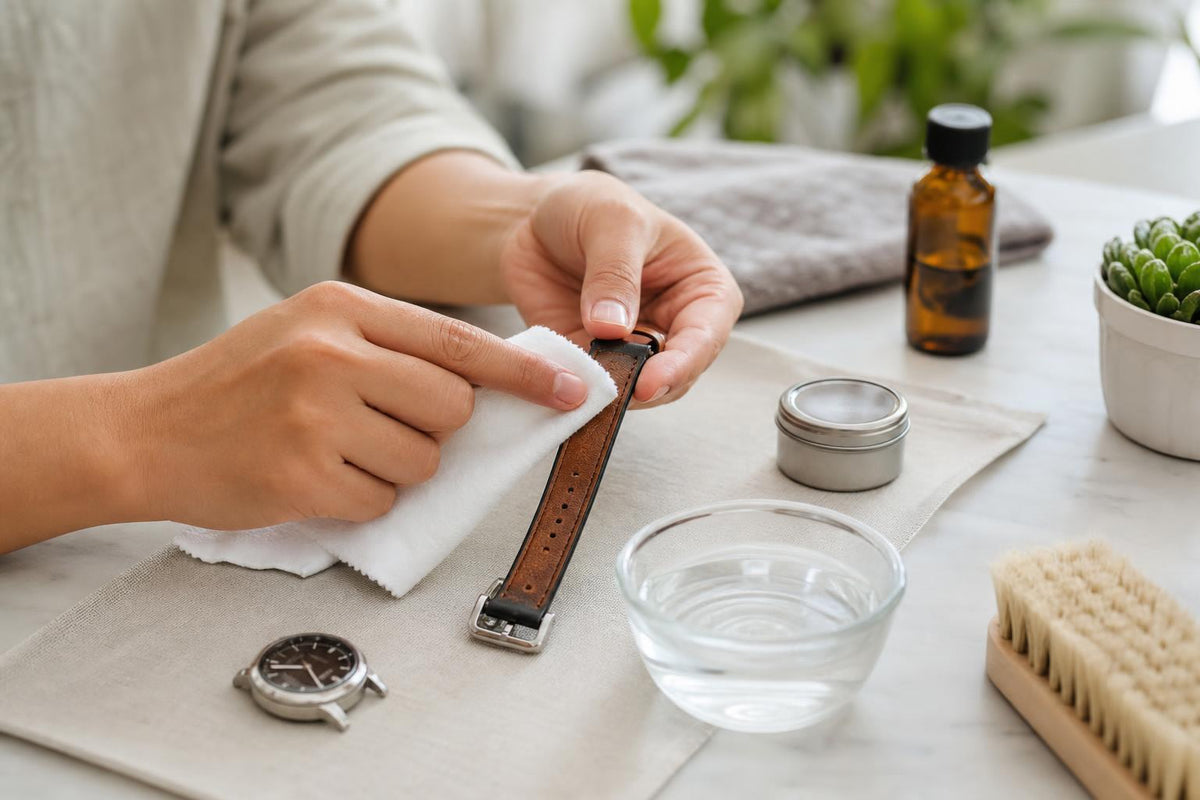
A leather watch band smells because sweat, skin oils, and bacteria accumulate on the underside during daily wear. To remove the smell safely, take the band off the watch, wipe it with a dry microfiber cloth, damp-clean the underside with a drop of mild soap, and let it air dry completely. For stubborn odor, place the dry strap in a sealed bag overnight with an open cup of baking soda or activated charcoal, keeping the powder off the leather. If the smell keeps returning or the leather is cracked and stiff, replacement is usually the smarter move.
Leather watch bands pick up smells. That is one of the trade-offs of wearing a natural material against warm, sweaty skin all day. The good news: most sweat odor from a leather watch band can be reduced with gentle cleaning and proper drying. The bad news: some smells, like cigarette smoke or deep mildew, may be permanent.
This guide covers what actually works to remove smell from a leather watch band, what to avoid, and when it is time to stop trying and get a new strap. No miracle hacks.
Browse full-grain leather Apple Watch bands if your current strap is already past saving.
Quick Answer: How to Remove Smell From a Leather Watch Band
- Remove the band from the watch or smartwatch.
- Dry wipe both sides with a microfiber or lint-free cloth.
- Damp-clean the underside with a barely damp cloth and one drop of mild, unscented soap.
- Remove soap residue with a second clean, barely damp cloth.
- Air dry completely in a cool, dry spot away from heat and direct sunlight.
- Deodorize if needed by placing the dry strap in a sealed bag or container with an open cup of baking soda or activated charcoal overnight. Keep the powder off the leather.
Apple’s official care guidance confirms that leather Apple Watch bands should be wiped with a nonabrasive lint-free cloth, lightly dampened if needed, never soaked, and air dried away from sunlight, heat, or high humidity.
Do not soak, bleach, alcohol-wipe, perfume, or hairdryer-blast the leather. Those methods cause more problems than they solve.
Why Leather Watch Bands Start to Smell
The smell is not the leather itself. Fresh leather has a natural earthy scent that most people find pleasant. The sour, stale, funky, or gym-bag odor that sends people searching for solutions comes from what gets trapped inside the leather during daily wear.
Sweat, skin oil, and bacteria
Your wrist sweats. Skin produces oils. Both soak into the underside of the band, where airflow is limited and moisture lingers. Bacteria on your skin then break down sweat compounds into volatile odor molecules, and that process creates the leather watch band smell people complain about. Research indexed on PubMed confirms that skin bacteria transform sweat into odorants like ammonia and short-chain fatty acids.
A 2023 Florida Atlantic University study found that 95% of sampled wristbands carried bacterial contamination, reinforcing that wrist-worn items are commonly overlooked during cleaning routines. The study included rubber, plastic, cloth, metal, and leather bands, though only one leather sample was tested. Treat the statistic as general wearable-hygiene evidence rather than leather-specific proof.
Moisture from handwashing, rain, and sweat
Leather is porous. It absorbs water and dries slowly compared to silicone or metal. Every time you wash your hands while wearing your watch, splash water on your wrist, or sweat through a workout, moisture enters the leather. If the band never fully dries between wears, that trapped moisture feeds bacteria and creates a cycle of worsening smell.
Practitioners on Reddit describe this exact pattern. One user on r/Leather explained that their watch strap repeatedly got wet from handwashing, then started to smell, and asked whether it could be saved. The real issue was not a one-time event but accumulated moisture over weeks of normal use.
Lotions, perfume, and sunscreen
Products applied to your wrist or hands can soak into leather and become their own odor problem. Apple warns that leather color can change from exposure to perfume, insect repellent, oil, lotion, and dyed materials like denim. Suunto gives similar warnings. Fragrance communities on Basenotes confirm that cologne gets stuck in leather watch bands for weeks because the leather absorbs the carrier oils.
Understanding how full-grain leather differs from bonded or top-grain leather helps here: full-grain leather’s intact surface absorbs and ages differently than coated or bonded alternatives, which affects both cleaning and odor retention.
Identify Your Smell Type First
Not all leather watch strap smells are the same, and they should not be treated the same way. A lightly sweaty strap needs a wipe and some air. A gasoline-soaked strap is probably trash. Diagnose the problem before choosing a fix.
| Odor Level | What You Notice | Likely Cause | Best Action | Replace? |
|---|---|---|---|---|
| Level 0: Natural leather | Earthy, tannery smell, not sour | Normal leather material odor | Air out in a cool dry place | No |
| Level 1: Light wrist smell | Mild sweat, noticeable only close up | Surface sweat and oils from daily wear | Dry wipe, air out overnight | No |
| Level 2: Sour or funky | Smells sour, vinegary, gym-like | Trapped sweat, oils, bacteria, moisture | Damp-clean, air dry, then baking soda or charcoal | Maybe, if it returns fast |
| Level 3: Musty or mildewy | Damp basement smell, possible spots | Mold or mildew from wet storage | Stop wearing, consider professional cleaning | Often yes |
| Level 4: Perfume or sunscreen | Fragrance stuck in leather | Absorbed oils and scent compounds | Air out, non-contact baking soda or charcoal | Maybe |
| Level 5: Smoke, gasoline, chemical | Cigarette, fuel, solvent smell | Volatile compounds absorbed into porous leather | Remove immediately, air out, usually replace | Usually yes |
Reddit threads consistently show that users dealing with fragrance, smoke, and fuel contamination on their leather watch bands move quickly toward replacement. Leather absorbs these compounds deeply, and surface cleaning rarely extracts them fully. One r/Watches thread about gasoline on an IWC leather strap ended with most commenters recommending a new band rather than escalating to harsh chemicals.
The Safe Cleaning Method: Clean, Dry, Deodorize, Condition
Most competitor guides treat “cleaning” and “odor removal” as the same thing. They are not. Cleaning removes sweat and oil residue. Drying removes moisture. Deodorizing reduces lingering odor molecules. Conditioning restores feel after cleaning dries out the leather.
Follow this sequence. Do not skip to soaking or harsh chemicals. For a broader walkthrough covering different band materials, see the full guide on how to clean a leather watch band.
Step 1: Remove the band from the watch
This protects electronics, lets you access the underside of the strap, and allows you to apply even pressure during cleaning.
Step 2: Dry wipe the surface
Use a microfiber cloth or lint-free cloth. Wipe both the top (visible) side and the underside (skin contact side). This removes surface dirt, dried sweat residue, and loose debris.
Step 3: Damp-clean the underside
Mix lukewarm water with a tiny amount of mild, unscented soap. Dip a microfiber cloth and wring it until barely damp, not dripping. Wipe the underside gently, paying attention to the area that sits against your skin.
Nixon recommends a damp microfiber cloth with one drop of mild unscented hand soap, followed by a clean damp cloth to remove residue. The key phrase is “barely damp.” You are not washing the leather. You are lifting residue from the surface.
Step 4: Remove soap residue
Wipe the cleaned area with a second cloth dampened with fresh water only. Soap residue left on leather attracts dirt and can dull the finish.
Step 5: Air dry completely
Lay the strap flat or hang it in a well-ventilated room at normal temperature. Do not use a hairdryer, radiator, or direct sunlight. Nixon warns that a hairdryer can dry and crack leather. Apple says not to store leather bands in direct sunlight, high temperatures, or high humidity.
Air drying matters because moisture trapped inside the leather is often the reason the sweat smell from a leather watch band comes back after cleaning. One practitioner on r/Watches advised letting the strap dry fully and not wearing it tight, noting that a snug fit traps sweat and slows drying.
Step 6: Condition sparingly (only if needed)
If the leather feels stiff or dry after cleaning, apply a small amount of leather conditioner. Spot-test on the underside first because conditioner can darken leather. Nixon says specialized leather conditioner and oils should be used sparingly and may change the shade.
Conditioner is not a deodorant. It restores flexibility after the cleaning and drying process strips some natural oils. For more detail on when and how to do this, see the guide on conditioning leather watch bands.
How to Deodorize With Baking Soda Without Damaging Leather
Baking soda is the most commonly recommended deodorizer for a smelly leather watch band, and it can work, but only for certain odors and only when used correctly.
Why it works (sometimes)
Baking soda is sodium bicarbonate, a weak base. McGill University’s Office for Science and Society explains that baking soda can react with acidic odor molecules like butyric acid, forming less volatile salts that don’t smell as strongly. This makes it useful against sour, sweaty, stale odors.
But not every smell is acidic. Baking soda will not remove embedded oils, grime, mold spores, or chemical contamination on its own. Think of it as a support step after cleaning, not a replacement for it.
The safer method: non-contact deodorizing
- Make sure the strap is completely dry after cleaning.
- Place it in a sealed zip bag or airtight container.
- Add an open cup, small dish, or breathable sachet of baking soda.
- Keep the powder away from the leather surface, especially stitching, perforations, suede nap, or unfinished edges.
- Leave sealed overnight, or up to 24 hours for stronger odors.
- Remove, air out briefly, and wear.
This approach avoids the risks of direct contact: residue caking in stitching, white powder staining suede, or moisture from a paste softening the finish. Several strap-care brands, including Watches & Crystals and HANDDN, recommend this non-contact version alongside activated charcoal packs.
What about direct baking soda paste?
Some guides recommend mixing baking soda with water and applying it directly to the leather. This is riskier. The paste introduces moisture, which is the opposite of what you want after cleaning. It can also leave chalky residue in stitching and perforations. If you choose to try it, spot-test on the underside of the strap first and accept the risk of finish changes on delicate leather.
Activated charcoal as an alternative
Activated charcoal packs work through adsorption (trapping odor molecules in their porous surface) and can be placed alongside or instead of baking soda. They are dry, leave no residue, and do not require contact with the leather. A good option for anyone who wants to deodorize a leather watch strap without introducing water or powder.
What Not to Use on a Smelly Leather Watch Band
The internet is full of aggressive cleaning hacks that can wreck a leather strap. Here is what to avoid and why.
| Method | Why to Avoid | Safer Alternative |
|---|---|---|
| Soaking in water | Leather is not water resistant. Soaking causes swelling, stiffening, discoloration, and accelerated wear. | Barely damp cloth wipe |
| Alcohol wipes | Apple allows alcohol wipes on some watch surfaces but explicitly says not to use them on leather or fabric bands. | Mild soap on a damp cloth |
| Bleach or hydrogen peroxide | Apple says not to use bleach or hydrogen peroxide on Apple Watch cleaning. These destroy leather color and structure. | Non-contact baking soda or charcoal |
| Vinegar | Some blogs recommend white vinegar, but Apple’s guidance calls for fresh water only on leather. One competitor article warns against vinegar in one section, then recommends it in another. Skip vinegar. | Non-contact baking soda deodorizing |
| Toothpaste | YouTube features toothpaste hacks, but toothpaste contains abrasives, fragrance, whiteners, and moisture. It is not part of any official leather care guidance. | Mild unscented soap on damp cloth |
| Perfume or cologne | Fragrance oils absorb into leather and become a lasting odor problem. Apple and Suunto both warn about fragrance exposure on leather. | Air out the strap in a ventilated space |
| Hairdryer or direct sunlight | Heat dries leather aggressively, causing cracking, stiffening, and discoloration. | Room-temperature air drying |
| Washing machine | Leather straps are not textile. Machine agitation, heat, and water volume will destroy the strap. | Hand cleaning with minimal moisture |
Citizen’s watch care guidance warns specifically that volatile materials, bleach, alcohol, and cosmetics can cause discoloration and premature aging on leather bands. The general rule: if a manufacturer does not specifically say to use a product on leather, do not use it.
When the Smell Means the Band Should Be Replaced
Sometimes the honest answer is that the strap is done. Leather watch bands are wear items, not permanent fixtures. Accepting that saves you from escalating to harsher chemicals that damage the leather further and may irritate your skin.
Replacement signs
Replace the strap if any of these apply:
- Sour odor returns within days of cleaning and full drying.
- The strap smells musty or moldy even after deodorizing.
- Gasoline, cigarette smoke, or chemical smell persists.
- Leather is cracked, peeling, stiff, or brittle.
- Stitching is loose or edges are fraying.
- The strap has been soaked multiple times.
- Wearing it causes skin irritation or rash.
How long do leather watch bands normally last?
This varies by quality and wear habits, but official brand guidance puts it in perspective. Hamilton says a leather strap under normal daily wear averages six to 12 months. Jaeger-LeCoultre recommends replacement around every 12 months. IWC says daily-worn leather straps average 12 to 18 months, while Cartier estimates about 24 months under normal conditions.
If your strap has been on your wrist daily for a year and smells despite proper cleaning, it has done its job. Replacing it is normal, not failure.
Looking for a replacement? Bayelon’s padded leather Apple Watch strap is handcrafted from full-grain leather and designed for daily casual wear.
How to Prevent Leather Watch Band Smell
Prevention is simpler than treatment. These habits stop the smell from building up in the first place.
Wipe after sweaty days. A quick dry microfiber wipe after a hot commute or a long meeting removes surface sweat before it soaks in.
Let the strap breathe overnight. Remove the watch at night and leave the strap in open air, not inside a closed drawer or watch box while still damp from the day.
Do not wear leather during workouts, swimming, or showering. Suunto recommends silicone for swimming and high-output activities. Garmin says leather and suede bands are not recommended for vigorous activity. If you track sleep or workouts, switch to a silicone or nylon band for those hours.
Rotate between straps. Alternating between two bands gives each one time to dry and recover between wears. This is especially helpful in summer or for people who sweat heavily. If you are building a rotation, the guide on choosing a leather watch band covers sizing, styles, and use cases.
Wear it with room for airflow. A band worn too tight against the skin traps sweat and slows evaporation. Apple’s own comfort guidance says the watch should be snug but not tight, with room for skin to breathe.
Keep products off the leather. Apply sunscreen, lotion, perfume, and hand sanitizer before putting the watch on, and let products dry first. These substances absorb into leather and become persistent odor sources.
Store in a cool, dry spot. Avoid humid bathrooms, hot cars, and sealed plastic bags for long-term storage. LinkedIn practitioners sharing the FAU wristband study emphasize that strap hygiene is partly a material-design problem, not just a user-cleaning problem, and that choosing the right strap material for the activity matters as much as cleaning does.
If you rotate straps, consider a second style like Bayelon’s leather watch band with rivet for a different look while your primary band airs out.
Key Leather Watch Band Terms to Know
These terms come up throughout leather care guides. Understanding them helps you make better decisions about cleaning, deodorizing, and replacing your strap.
Patina. The natural darkening and character that leather develops with use over time. Patina is visual aging, not odor. Apple notes that leather usually develops patina after normal wear. A strap with rich patina that smells fine is working exactly as intended.
Porous leather. Leather has a fibrous structure that absorbs moisture, oils, and odor compounds. This is why it feels comfortable against skin but also why repeated sweat and wetting lead to smell. Hook+Gaff explains that genuine leather straps are porous and not completely waterproof.
Moisture saturation. When the strap has absorbed water or sweat into the leather rather than just having moisture on the surface. Saturated leather dries slowly, traps odor, and can stiffen, discolor, or crack. If your band is saturated, remove it, blot it dry, and air dry fully before wearing again.
Mild soap. A gentle, low-residue soap used in tiny amounts on a damp cloth. Not poured onto leather. Not dish soap with added fragrance. Think plain, unscented hand soap.
Saddle soap. A traditional leather-cleaning product. It can work on durable finished leather, but always test a hidden area first. Not every watch strap finish handles it well.
Strap rotation. Alternating between two or more bands so each gets time to dry and rest. One of the most effective prevention strategies for keeping leather watch band odor from building up.
Replacement threshold. The point where cleaning risks more damage than benefit. When the leather is cracked, stiff, moldy, or permanently odor-saturated, more water, stronger chemicals, or aggressive scrubbing will not fix it. It will make things worse.
Frequently Asked Questions
Can I wash a leather watch band with soap and water?
You can use a tiny amount of mild soap on a barely damp cloth for most finished leather straps. Do not soak, rinse, or submerge the leather. Apple confirms that leather bands are not water resistant and should not be soaked. The goal is to lift residue from the surface, not to wash the band like clothing.
Can I use baking soda on a leather watch band?
Yes, but the safest approach is indirect. Place the dry band in a container with an open cup of baking soda overnight, without letting the powder touch the leather directly. Direct paste can leave residue, introduce moisture, and affect delicate finishes. Baking soda works best on sour or sweaty odors because it neutralizes acidic odor molecules.
Can I use vinegar to remove leather watch band smell?
Avoid vinegar as the default fix. Apple’s care guidance for leather bands specifies fresh water only. Some blogs recommend white vinegar, but this advice often conflicts with their own warnings about acidic substances on leather. The safer route is non-contact baking soda or activated charcoal.
Why does my leather watch band smell like vinegar?
A sour or vinegar-like smell from a leather watch strap is usually stale sweat and skin oils trapped in the underside of the band, combined with bacterial activity. Clean the underside gently, dry fully, and deodorize only after the leather is completely dry. If the sour smell returns quickly after thorough cleaning, the strap may be past saving.
Can I use alcohol wipes on an Apple Watch leather band?
No. Apple allows 70% isopropyl alcohol wipes on certain watch surfaces and some non-leather bands, but explicitly says not to use them on leather or fabric bands.
Why does the smell come back after cleaning?
The strap may still hold moisture, oils, or odor deep in the leather fibers. It could also be worn too tightly, preventing proper drying between wears. A practitioner on r/Leather noted that wiping with water reduced sweat smell but did not eliminate it, and a commenter suggested saddle soap followed by conditioner for deeper cleaning. Air removes moisture, cleaning removes residue, and deodorizing handles what remains. If odor keeps returning despite all three steps, the leather has likely reached its replacement threshold.
Is a leather band okay for workouts?
Leather is best for casual daily wear, not exercise. Suunto recommends silicone for swimming and high-output activities. Garmin says leather bands are not recommended for vigorous activity. If you want to track workouts or sleep, keep a silicone or nylon band for those sessions and save the leather for everything else.
How often should I replace a leather watch band?
It depends on wear habits and leather quality. Hamilton gives six to 12 months for normal daily wear. Jaeger-LeCoultre recommends about 12 months. IWC says 12 to 18 months, and Cartier estimates about 24 months. Higher-quality full-grain leather tends to last longer, but no leather strap is permanent under daily sweat and friction.
A leather watch band that smells is not ruined, at least not always. The fix is a simple sequence: clean the sweat, dry the leather, deodorize gently, and condition only when needed. Skip the miracle hacks. Use less water, not more. And if the strap keeps fighting you, a replacement is the practical answer.
If you are shopping for your next strap, Bayelon’s handcrafted leather Apple Watch bands are made from full-grain leather and built for daily casual wear, with 30-day returns and free U.S. exchanges.


Leave a comment
This site is protected by hCaptcha and the hCaptcha Privacy Policy and Terms of Service apply.