
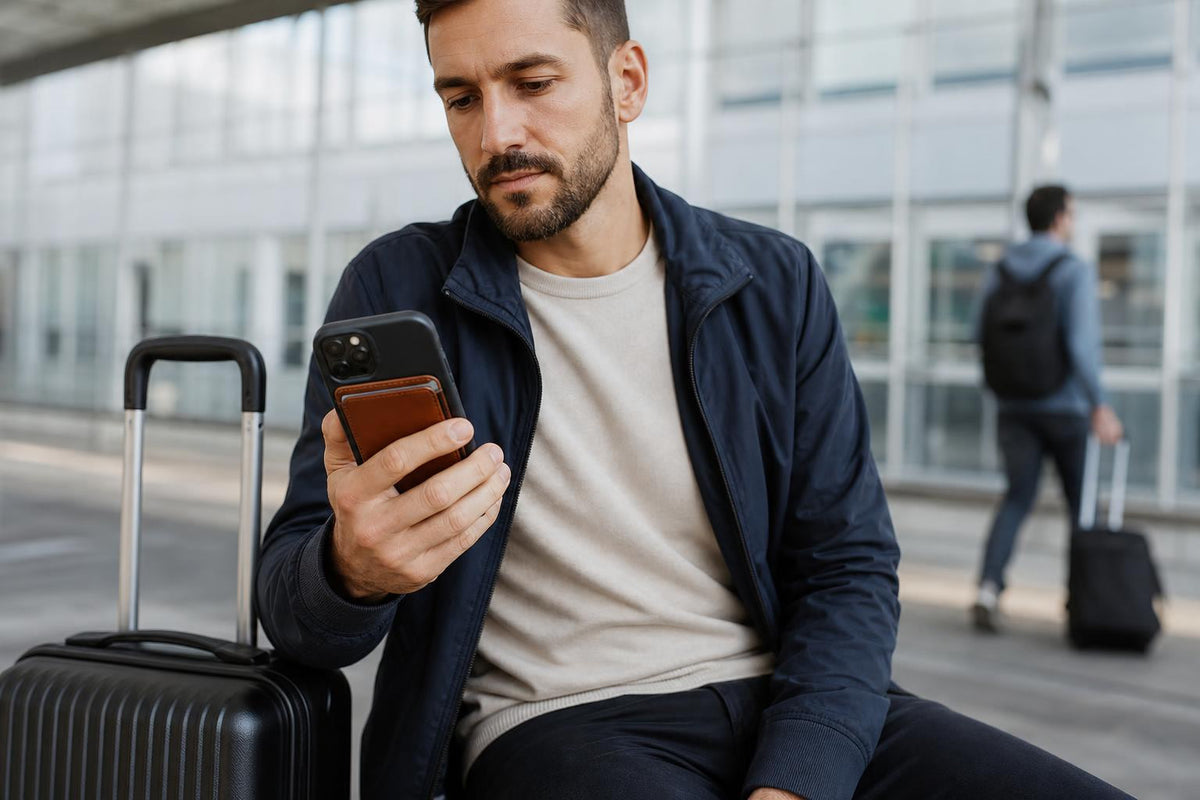
TL;DR
Finding a durable phone wallet for frequent travelers comes down to five things: material grade (full-grain leather outlasts everything else), drop protection (dual-layer construction is non-negotiable), secure closure, hands-free carry options, and MagSafe compatibility for rental car mounts. Budget PU leather cases peel within months of heavy travel use. A full-grain leather detachable wallet case offers the best balance of durability, flexibility, and everyday convenience for people who are constantly on the move.
Why Most Phone Wallets Fail Travelers
The appeal of a phone wallet case is obvious. One item to track through airports, rideshares, and hotel lobbies instead of two. Your phone, credit card, ID, and hotel keycard all live in the same place. For frequent travelers, this consolidation is a genuine quality-of-life upgrade.
The problem is that most wallet cases are not built for the kind of punishment travel inflicts. Temperature swings between air-conditioned terminals and scorching rental car dashboards. Constant friction from pockets, bags, and seatback pockets. Humidity at beach destinations. The mechanical stress of being pulled out and flipped open dozens of times a day.
Practitioners on Reddit’s r/TravelHacks consistently report that their biggest concern isn’t fancy features. It’s keeping their phone and cards physically secure and accessible throughout a trip. And the most common complaint about budget wallet cases across review platforms? Peeling. One verified buyer on a major marketplace noted that “the covering material began to flake off in just a few weeks.” Another flagged a product as “NOT leather…polyurethane” despite being marketed as leather.
There’s also the eggs-in-one-basket concern. One travel writer put it well: bi-fold options with multiple slots can be heavy, and they put all your eggs in one basket. If you lose your phone, you lose all your essentials. That tension is exactly why both durability and design matter when choosing a phone wallet for travel.
This guide covers the specific features that separate a travel-worthy phone wallet from the ones that fall apart by your third trip.
Browse Bayelon’s best-selling wallet cases to see what full-grain leather options look like in practice.
At-a-Glance Comparison: Phone Wallet Types for Travel
| Type | Material | Card Capacity | MagSafe Support | Crossbody Option | Kickstand | Approx. Price |
|---|---|---|---|---|---|---|
| Full-grain leather detachable wallet | Full-grain leather | 3-5 cards | Yes (when detached) | Model-dependent | Yes (wallet flap) | $70-$120 |
| Full-grain leather crossbody case | Full-grain leather | 2-4 cards | Model-dependent | Yes (leather strap) | Varies | $60-$110 |
| Full-grain leather trifold/folio | Full-grain leather | 4-6 cards | Model-dependent | No | Yes (wallet flap) | $70-$130 |
| MagSafe snap-on wallet | Mixed (leather/fabric) | 1-3 cards | Yes | No | Varies | $30-$60 |
| PU leather folio | Synthetic PU | 3-5 cards | Rarely | Rarely | Sometimes | $15-$40 |
| Crossbody phone pouch | Nylon/leather/fabric | 3-6+ cards | No | Yes | No | $25-$80 |
The Durability Checklist: What to Evaluate Before You Buy
Before looking at specific products, you need to know what separates a durable phone wallet from a disposable one. These are the criteria that matter most for frequent travelers.
Material Grade: The Single Biggest Durability Factor
This is where most buyers get burned, and where most buying guides fall short.
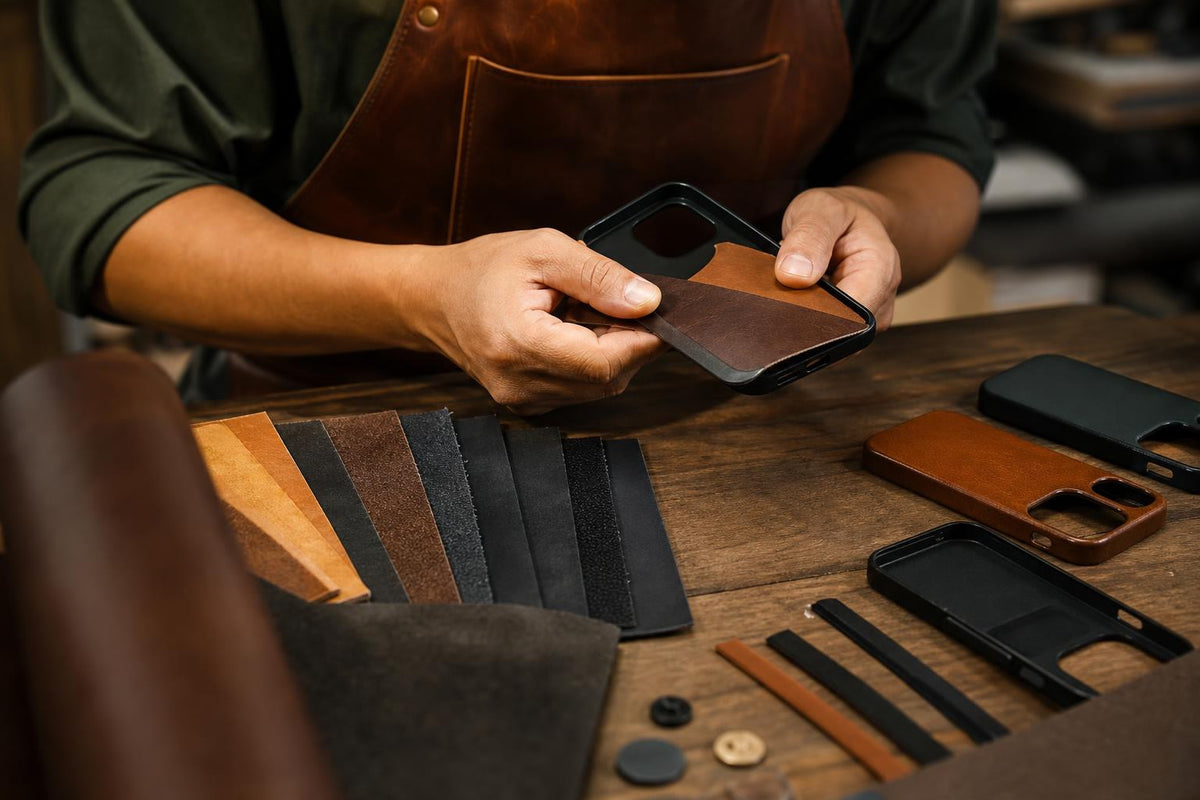
Full-grain leather uses the entire hide with its natural grain intact. It’s the most durable grade of leather and develops a rich patina over time, actually looking better with age rather than worse. Top-grain leather has been sanded smooth for a more uniform appearance, but sacrifices some of that character and longevity. Then there’s “genuine leather,” which sounds premium but is actually made from lower-quality scraps. And PU (polyurethane) leather is fully synthetic.
For travelers, the performance gap between these materials is dramatic. PU leather exposed to high heat (think: inside a car on a summer day in Phoenix or Rome) can soften, deform, or peel over time. Full-grain leather handles temperature swings and humidity far more gracefully, especially with occasional conditioning.
Here’s the cost math that matters. A $35 PU folio case offers roughly 80% of the wallet functionality at about 30% of the cost of a full-grain case. That sounds like a deal until you calculate the cost per month. Replace that $35 case twice in two years (which is common based on user complaints about peeling), and you’ve spent $105. A $99 full-grain leather case that lasts three years costs $2.75 per month. Full-grain leather is rarely used in mass-market phone cases because of the higher material and production costs, but the per-use economics favor it heavily for anyone who uses their case daily.
If you want to go deeper on identifying quality leather, this guide to spotting full-grain versus faux walks through the visual and tactile tests.
Drop Protection: Leather Alone Isn’t Enough
A common misconception: leather cases are protective. Pure leather offers zero shock absorption. Its role is scratch resistance and grip enhancement. For actual impact protection, you need hybrid construction, a hard polycarbonate core combined with a flexible TPU bumper that absorbs shock on impact.
Look for cases that specifically mention dual-layer construction and raised edges around the screen and camera. When you set your phone face-down on a café table in Barcelona or a nightstand in Tokyo, those raised edges are the difference between a working screen and a cracked one.
Closure Security
How your wallet case stays shut matters more during travel than daily desk-to-car commutes. A magnetic closure is the minimum standard. It keeps the case from flopping open when you pull it out of a bag, which prevents cards from sliding out. For crowded transit situations (the Paris metro, Bangkok’s BTS), a stronger magnetic closure or even a zipper gives extra peace of mind.
Card Slot Construction
One frequent buyer of handmade leather wallet cases on Etsy noted that their first phone wallet case was cheap silicone that translated into “a tired, somewhat grimy look over time.” Beyond aesthetics, poorly constructed card slots stretch out. After a few months, cards start sliding around freely instead of staying snug.
Look for reinforced stitching and slots designed to hold cards firmly without requiring you to wrestle them out. Avoid pull-tab designs, which tend to stretch faster under frequent use.
Travel-Specific Features That Actually Matter
Beyond basic durability, certain features become significantly more valuable when you travel regularly. Here’s what to prioritize and what to treat as optional.
Crossbody and Hands-Free Carry
This is the feature that frequent international travelers care about most, based on forum discussions across Reddit, TripAdvisor, and Fodor’s. The conversation almost always circles back to physical security.
A crossbody phone case keeps your device on your body at all times. You’re able to have your phone accessible without holding it in your hand or burying it in a pocket or bag where it’s vulnerable. One frequent traveler on a Fodor’s forum recommended a cross-strap setup where zippers and closures face the body, noting that while a good pickpocket can get into anything, this approach deters fumbling attempts.
For parents traveling with kids, the hands-free benefit is equally practical. You’re not choosing between holding your child’s hand and holding your phone.
MagSafe and Qi2 Compatibility
If you rent cars abroad, MagSafe compatibility is a practical feature rather than a luxury. Pop your phone onto a magnetic car mount for navigation without fumbling with clamps or suction cups. In hotels, MagSafe stands let you charge your phone upright on the nightstand while using it as an alarm clock.
The key consideration: MagSafe charging typically only works when a wallet attachment is detached from the phone. This is why detachable designs have a distinct travel advantage. You can learn more about how Qi2 works with cases if you’re unfamiliar with the technology.
Detachable Wallet Design
This is the form factor that makes the most sense for varied travel days. Heading out for a full day of sightseeing with transit cards and cash? Use the full wallet configuration. Going to dinner where you only need your phone and one card? Detach the wallet portion and carry just the slim case.
The tradeoff is real, though. Magnetic hold can weaken if the wallet portion is overloaded with too many cards. Stick to 2-4 cards in the wallet section to maintain a secure connection.
Integrated Kickstand
No ranking travel guide adequately covers why a kickstand matters for travelers, but the use cases are constant. Propping up your phone for a video call from a hotel room. Watching downloaded content on a long flight. Following a recipe during an extended Airbnb stay. Using your phone as a navigation display in a café while you eat. A wallet flap that doubles as a kickstand eliminates the need to carry a separate stand or lean your phone against a water bottle.
RFID Blocking: The Honest Take
Most phone wallet guides mention RFID blocking as a must-have travel feature. The reality is more nuanced. RFID skimming has essentially zero documented cases in the US, Canada, UK, Australia, or Western Europe. Physical pickpocketing remains the overwhelmingly dominant risk for travelers.
That said, passports and Enhanced Driver’s Licenses use RFID-related technology, so RFID protection can be a practical add-on if you carry those documents in your phone wallet. The better framing: RFID blocking is a nice bonus, not a deciding factor. Spend your evaluation energy on physical security features (crossbody straps, secure closures) instead. For a deeper breakdown, see this analysis of whether you actually need an RFID blocker.
Phone Wallet Types Ranked for Travel Durability
1. Full-Grain Leather Detachable Wallet Case
Best for: Travelers who want maximum flexibility across different daily scenarios.
This is the most versatile format for frequent travel. A magnetic connection lets you switch between a full wallet configuration (sightseeing, airport, transit) and a slim back cover (dinner, gym, beach). MagSafe and Qi2 charging work when the wallet section is detached, so you’re not sacrificing wireless charging convenience.
Key features to look for:
- 100% full-grain leather exterior that develops patina over time
- Dual-layer protection (PC core + TPU bumper) for drop resistance
- Raised edges protecting screen and camera
- Magnetic detach mechanism
- Wallet flap that doubles as a kickstand
- MagSafe/Qi2 compatibility
- 3-5 card slot capacity
Tradeoffs:
- More expensive upfront than PU alternatives
- Magnetic connection can loosen if overstuffed with cards
- Adds 2-4mm thickness compared to a standard case
Bayelon’s detachable wallet case for iPhone 17 Pro Max checks all of these boxes. It uses 100% full-grain leather with military-style dual-layer protection and a magnetic detach system. Available in colorways like Rustic Tan, Dark Brown, and Smoked Black. Bayelon also offers 30-day free returns within the US and a 90-day manufacturer’s warranty, which removes the risk if the case doesn’t fit your travel style.
For Samsung users, the Galaxy S24 detachable wallet case offers the same construction and design approach.
2. Full-Grain Leather Crossbody Phone Case
Best for: International travelers concerned about pickpocketing, and parents who need hands-free carry.
The crossbody format directly addresses the number one security concern that comes up in every travel forum discussion: keeping your phone physically attached to your body. A leather shoulder strap keeps the case against your torso, with closures facing inward where pickpockets can’t easily reach them.
Key features to look for:
- Leather crossbody strap (adjustable length)
- Secure closure facing the body
- Full-grain leather for durability
- 2-4 card slots
- Drop protection
Tradeoffs:
- Less discreet than a pocket carry
- Strap can be uncomfortable in very hot weather
- Not always MagSafe compatible depending on design
Bayelon’s Galaxy S24 Ultra crossbody wallet case is built for exactly this use case, with a leather shoulder strap and full-grain construction.
3. Full-Grain Leather Trifold Wallet Case
Best for: Business travelers who carry 3+ cards and want full screen protection.
The trifold design maximizes card capacity while keeping the phone’s screen fully covered when closed. This is the format that works best if you carry multiple credit cards, a transit pass, business cards, and an ID while traveling for work.
Key features to look for:
- Higher card capacity (4-6 slots)
- Full screen protection when closed
- Integrated kickstand via wallet flap
- Full-grain leather construction
Tradeoffs:
- Bulkiest option of the three leather formats
- Puts all essentials in one place (the eggs-in-one-basket concern)
- Can feel cumbersome for casual sightseeing
The iPhone 17 Pro trifold wallet case from Bayelon fits this category, with multiple card slots and a kickstand.
4. MagSafe Snap-On Wallet
Best for: Minimalists who carry 1-2 cards and prioritize wireless charging above all else.
These are the slimmest wallet option. They snap onto the back of your phone magnetically, hold a couple of cards, and pop off when you need to charge wirelessly or use a car mount. Wired reviewed several of these in July 2026 and they remain popular for their simplicity.
Key features:
- Ultra-slim profile
- Instant MagSafe attach/detach
- Works with any MagSafe-compatible case
- Typically 1-3 card capacity
Tradeoffs:
- Minimal storage, less ideal for anyone needing more than 2-3 cards
- Can detach if snagged on something
- No screen protection whatsoever
- Magnetic hold weakens if overstuffed
- Often made from synthetic materials rather than full-grain leather
Practitioners on Reddit note these work best as a supplement to a regular case rather than a complete wallet replacement.
5. PU Leather Folio Wallet Case
Best for: Occasional travelers on a tight budget who need a temporary solution.
At $15-$40, PU folio cases deliver most of the wallet functionality at a fraction of the cost. They’re fine for a single vacation or occasional weekend trips.
Key features:
- Low upfront cost
- Wide availability for nearly every phone model
- Usually includes multiple card slots and a cash pocket
Tradeoffs:
- PU leather may stiffen in cold climates and become tacky in high humidity
- Peeling is the number one durability complaint across buyer reviews
- No meaningful drop protection in most designs
- Often marketed misleadingly as “leather” when they’re entirely synthetic
- Typically needs replacement within 6-12 months of daily use
If budget is your primary concern, a PU folio works as a stopgap. Just know that the cost-per-use math favors investing in full-grain leather over time.
6. Crossbody Phone Pouch (Dedicated Accessory)
Best for: Travelers who want a full bag replacement, not just a phone case.
These are standalone pouches or small bags designed to hold a phone plus additional items (cash, passport, earbuds). They’re popular as fashion accessories and offer more total storage than any phone case format.
Key features:
- Largest carrying capacity
- Can hold passport and other non-card items
- Crossbody strap for security
- Completely phone-model-agnostic
Tradeoffs:
- Bulkier than any case-based solution
- Harder to quickly use your phone (must unzip, remove, then replace)
- Often fashion-forward over functional
- Phone bounces around inside without a snug fit, increasing drop risk when removing it
How to Handle Your Phone Wallet at Airport Security
This is the practical detail that most buying guides skip entirely. TSA recommends putting items like keys, wallets, and cell phones directly into your carry-on bag rather than into the checkpoint bin. There’s a good reason for this: phones are reportedly among the most commonly stolen items at security checkpoints. TSA recovers approximately 100,000 lost items per year, many of them electronics left in bins.
A travel expert shared a strong rule of thumb: never put your phone directly into one of the security containers. Always tuck it into a zipped pocket in your carry-on bag.
A wallet phone case actually helps with this workflow. Instead of juggling a separate phone and wallet at the conveyor belt, you keep the whole unit in your carry-on bag’s inner pocket. Remove the phone from the case only if instructed by security for scanning, and keep your cards either in the case or in your hand.
If you’re looking to complete your travel setup with matching leather accessories, Bayelon also makes leather luggage tags that pair well with their cases.
Leather Care Tips for Travelers
Full-grain leather is low-maintenance, but it does need occasional attention, especially under travel conditions.
Routine care: Clean your leather case with a damp cloth and condition it every 3-4 months with a pH-neutral leather cream. This keeps the leather supple and prevents drying or cracking. Full-grain leather develops a natural patina over time, softening slightly and darkening evenly, which is part of its appeal.
Travel-specific tips:
- Don’t leave your case on a hot car dashboard. While full-grain leather handles heat better than PU, prolonged direct sun exposure will dry it out.
- After a beach or pool day, wipe off any salt water, sunscreen, or sand with a damp cloth. Let the case air dry naturally rather than using a hair dryer or placing it near a heater.
- Let the case breathe overnight. Don’t leave it sealed inside a bag or backpack when you’re sleeping. Set it on the nightstand.
- If it gets wet in rain, pat it dry and let it air dry at room temperature.
For a more detailed routine, the leather care guide covers conditioning frequency, product recommendations, and what to avoid.
FAQ
Is a phone wallet safe for international travel?
Yes, with a caveat. You’re consolidating essentials into one item, which means losing it has bigger consequences. The smart approach: carry only 2-3 cards in your phone wallet (one payment card, one ID, one hotel key) and keep backups locked in your hotel safe. Use Apple Pay or Google Wallet as your primary payment method where possible, so your physical cards are a backup rather than a necessity.
Will a wallet case work with my rental car mount?
If the case is MagSafe or Qi2 compatible and has a detachable design, yes. Detach the wallet portion, snap the phone onto the magnetic car mount, and use it for navigation. This is one of the biggest practical advantages of the detachable format for travelers.
How many cards should I carry in my phone wallet while traveling?
Two to three maximum. One payment card, one form of ID, and one utility card (hotel key, transit pass). This keeps the case slim, maintains a strong magnetic connection on detachable models, and limits your exposure if the case is lost or stolen.
Does RFID blocking actually matter for travel?
Not as much as marketing suggests. There are essentially zero documented cases of RFID skimming theft in the US, UK, Canada, or Western Europe. Physical pickpocketing is the real risk. RFID blocking is a reasonable bonus feature if the case already has it, but it should not be a deciding factor. Focus on physical security features like crossbody straps and secure magnetic closures instead.
What’s the difference between a folio case and a detachable wallet case?
A folio case is a single unit: the phone and wallet sections are permanently connected. A detachable wallet case uses magnets to let you separate the wallet portion from the phone case. For travel, detachable designs win on flexibility because you can switch between configurations throughout the day and retain wireless charging functionality.
How long does a full-grain leather phone wallet last?
With basic care (wiping down and conditioning every few months), a full-grain leather wallet case can last 2-3 years of daily use. That’s significantly longer than PU leather cases, which commonly start peeling within 6-12 months. The leather also looks better over time rather than worse, developing the patina that many leather enthusiasts specifically seek out.
What if I prefer keeping my phone and wallet separate?
That’s a valid preference, especially if consolidation makes you nervous. Consider pairing a slim leather phone case with a standalone leather card holder. You’ll carry two items instead of one, but you eliminate the single-point-of-failure risk. Many frequent travelers carry a phone wallet case as their primary setup and keep a slim backup card holder in their bag.
Can I use a phone wallet case for both travel and everyday carry?
Absolutely. The detachable format is specifically designed for this. Use the full wallet configuration for commuting and travel, detach it for a slim profile at the gym or on a night out. This dual-purpose functionality is what makes a quality phone wallet worth the investment over buying separate cases for different situations.

Leave a comment
This site is protected by hCaptcha and the hCaptcha Privacy Policy and Terms of Service apply.