
TL;DR
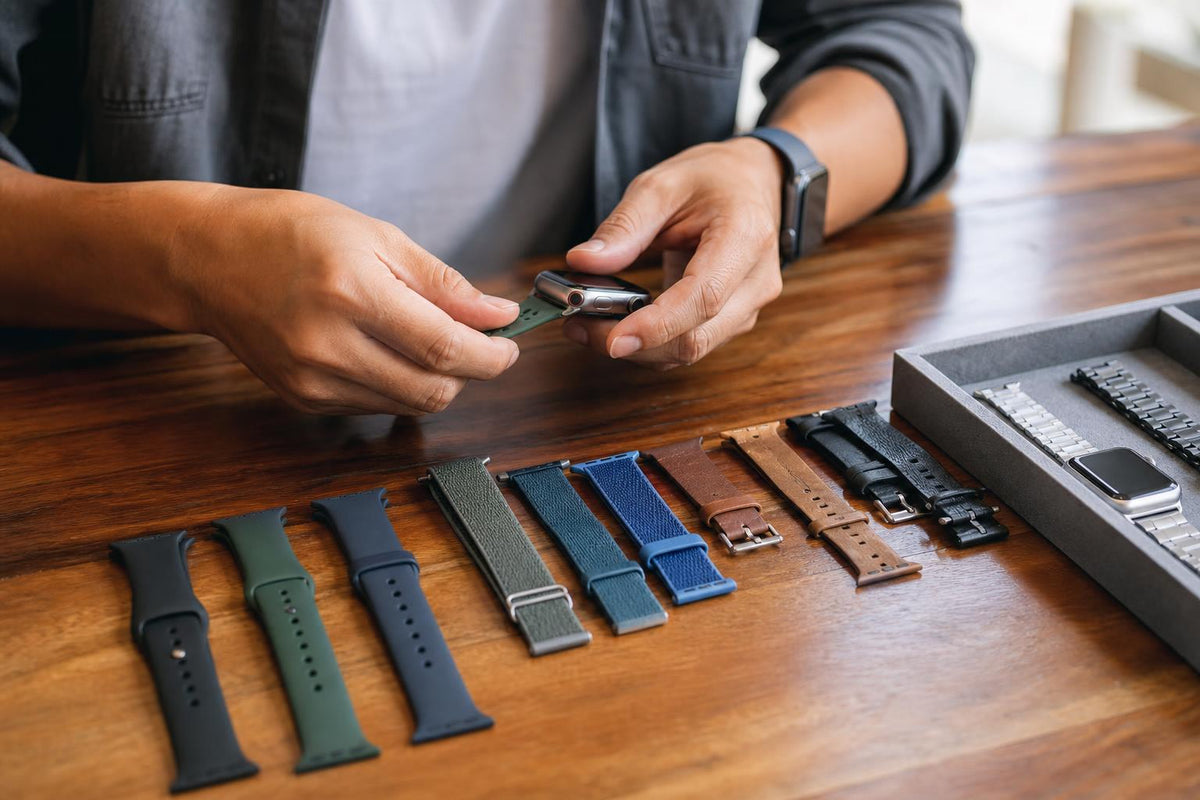
Apple Watch bands fall into two connector families (small and large), and picking the right one starts with knowing your case size. The term “42mm” now means different things depending on your watch generation, which trips up many buyers. Measure your wrist circumference with a flexible tape, match it to S/M or M/L band lengths, and pick a material that fits your lifestyle. Leather develops character over time but skip it for workouts, silicone handles sweat, and metal dresses things up.
Why Choosing an Apple Watch Band Feels Harder Than It Should
There are over a dozen materials, two size families, numbered Solo Loop sizes, and a naming system where the same millimeter measurement can mean opposite things depending on when you bought your watch. No wonder people feel lost.
This guide works like a glossary. Each term is defined, explained, and connected to the buying decision it affects. Whether you’re replacing a worn-out band or picking your first one, these are the concepts you need to understand before spending money.
If you’re specifically looking at leather options, browse Bayelon’s collection of full-grain leather Apple Watch bands to see what’s available.
Size and Fit Terms
Understanding how to choose an Apple Watch band starts here. Size compatibility is the single most important factor, and getting it wrong means your new band won’t physically attach to your watch.
Case Size
The millimeter measurement of your Apple Watch body. This number determines which bands are compatible. You can find it engraved on the back of your watch, or open the Watch app on your iPhone and go to My Watch, then General, then About.
Apple has used these case sizes over the years: 38mm, 40mm, 41mm, 42mm, 44mm, 45mm, 46mm, and 49mm.
Connector Family (Small vs. Large)
This is the concept that simplifies everything. Apple Watch bands are not universally interchangeable, but they are compatible within the same size group. Apple uses two connector families:
| Small Family | Large Family |
|---|---|
| 38mm (Series 1-3) | 42mm (Series 1-3) |
| 40mm (Series 4-6, SE) | 44mm (Series 4-6, SE) |
| 41mm (Series 7-9) | 45mm (Series 7-9) |
| 42mm (Series 10-11) | 46mm (Series 10-11) |
| 49mm (Ultra, Ultra 2) |
Any band within a family fits any watch in that same family. A band made for the original 38mm Apple Watch from 2015 still works on the 42mm Series 11 today. That backward compatibility has held for over a decade.
Lug and Lug Width
The lug is the slot on the watch body where the band clicks in. Lug width refers to how wide that slot is: 20mm for the small connector family, 22mm for the large. You rarely need to think about lug width when buying Apple-compatible bands (the connector system handles it), but it matters if you’re considering universal watch straps with third-party adapters.
S/M and M/L
These are band length designations, not watch sizes. Most Apple bands ship in one of two lengths:
- S/M fits wrists approximately 130mm to 180mm (about 5.1" to 7.1")
- M/L fits wrists approximately 150mm to 200mm (about 5.9" to 7.9")
There’s deliberate overlap in the middle. If your wrist measures between 160mm and 180mm, either length works. S/M will feel snugger, M/L more relaxed. For a deeper breakdown of specific measurements by band type, check out this Apple Watch band size guide.
Solo Loop Size (1 through 9)
Solo Loops have no clasp, buckle, or adjustability. They stretch over your hand and sit on your wrist. Because of this, they use a numbered sizing system from 1 to 9, with each size increasing by roughly 4 to 5mm in wrist circumference. Apple offers a printable sizing tool on their website, and Apple Stores can measure you in person.
Getting Solo Loop sizing right matters more than with any other band type. Too large and the watch slides around. Too small and it digs into your skin.
Wrist Circumference
The measurement around your wrist, taken just above the wrist bone with a flexible tape measure. If you don’t have a tape measure, wrap a strip of paper around your wrist, mark where it overlaps, and measure the strip flat with a ruler. This single number determines your band length for every band type except Solo Loops (which use their own numbered system).
The 42mm Confusion: Read This Before You Buy
This deserves its own section because it causes real problems. Practitioners on Reddit have created compatibility charts specifically because Apple’s naming makes this so confusing.
Here’s what happened: the original Apple Watch Series 1 through 3 came in 38mm (small) and 42mm (large). For years, 42mm meant the bigger watch. Then Apple released the Series 10 and 11, which come in 42mm (small) and 46mm (large). Now 42mm means the smaller watch.
The critical point: the old 42mm and the new 42mm use different connectors. A band bought for a Series 3 (42mm) will not fit a Series 11 (42mm). The old 42mm belongs to the large connector family. The new 42mm belongs to the small connector family.
If you’re upgrading from a Series 3 to a Series 11, check the connector family table above before assuming your old bands will carry over. The numbers match, but the hardware does not.
Material Terms
Material choice is where personal preference takes over from technical compatibility. When figuring out how to choose an Apple Watch band material, think about where you’ll wear it, how much maintenance you want to do, and whether you care about how it ages.
Silicone (Fluoroelastomer)
The default Apple Watch band material. Apple’s version is technically fluoroelastomer, which is more durable and resistant to UV degradation than generic silicone. It’s lightweight, waterproof, easy to clean, and handles sweat without complaint. The trade-off is that it can trap moisture against your skin during long wear, and some people find it too casual for business settings.
Nylon (Sport Loop)
A woven fabric band with a hook-and-loop (Velcro-style) closure. It’s the lightest Apple Watch band available and infinitely adjustable, which makes it popular with people who find buckles annoying. Nylon absorbs water, so it’s not ideal for swimming. Give it a rinse after sweaty workouts to prevent odor buildup. For material-specific cleaning steps, this guide on how to clean Apple Watch bands covers nylon and other materials.
Full-Grain Leather
The top tier of leather. Full-grain uses the outermost layer of the animal hide with all its natural markings intact. It’s the strongest and most durable grade because the fiber structure hasn’t been altered. Over time, it develops a patina (more on that below) that makes each band unique. Full-grain leather is not sweat-friendly. Remove a leather band before workouts, and let it air out regularly.
If you want to understand leather grades more deeply, this comparison guide explains how to identify full-grain leather versus imitations.
Top-Grain Leather
The second-highest leather grade. The surface has been sanded and refinished to create a uniform appearance. It’s thinner and more pliable out of the box than full-grain, but it develops less character over time. Many premium-branded watch bands use top-grain leather, and it’s a perfectly good material. Just know that it won’t age the same way full-grain does.
Genuine Leather
This label sounds reassuring, but it’s essentially meaningless as a quality indicator. “Genuine leather” can refer to any real leather, from excellent to barely passable. User reviews on eBay reflect the confusion, with one buyer noting that a band labeled “genuine leather” felt “more like a fake leather or a soft plastic” and advised people wanting quality to look elsewhere. When shopping, ask specifically whether the leather is full-grain or top-grain. If a seller only says “genuine leather” and won’t specify further, that’s a red flag.
Bonded Leather
Ground-up leather scraps mixed with polyurethane and pressed into a sheet. It’s the lowest quality material that can legally be called leather in some contexts. Bonded leather cracks and peels quickly, especially on a watch band that gets constant flexing and skin contact. Avoid it.
Stainless Steel
Heavy, formal, and extremely durable. Apple’s Milanese Loop uses a braided mesh design with a magnetic clasp that’s infinitely adjustable. The Link Bracelet is a traditional metal watch band with removable links. Both add significant weight to your wrist compared to silicone or nylon. Stainless steel works for office settings and dressier occasions but can pull arm hair and feels cold in winter.
Titanium
The premium metal option, designed primarily for the Apple Watch Ultra line. Titanium is lighter than stainless steel while maintaining similar strength. It’s corrosion-resistant, which makes it suitable for outdoor and water activities. The price tag is steep.
Fine Woven
Apple’s textile alternative to leather, introduced after Apple discontinued its own leather bands. It’s a worth-mentioning material, but honesty matters here: Apple’s Fine Woven degraded badly enough that Apple discontinued the phone cases made from it, though the watch bands are still sold. If you’re considering Fine Woven, factor in that it may not hold up as long as you expect.
Style and Feature Terms
Beyond size and material, watch bands have specific design features worth understanding. These terms come up constantly in product listings and reviews, and knowing what they mean helps you compare options accurately when learning how to choose an Apple Watch band that actually fits your style.
Patina
The gradual darkening and softening of leather through exposure to skin oils, sunlight, and handling. Full-grain leather develops the richest patina because its surface hasn’t been altered. The effect is cumulative: a band that looks uniformly brown on day one might show warm honey tones and darker edges after six months. Patina is a feature of quality leather, not a defect. For more on how leather ages and what to look for, that linked guide goes deeper.
Break-In Period
New leather bands feel stiff. That’s normal. Expect 1 to 2 weeks of regular wear before a leather band softens and conforms to your wrist shape. During this time, the band might feel tighter or less comfortable than you expected. Don’t return it prematurely. The break-in period is part of how leather works, and the band will feel noticeably different after it adjusts.
Padded Strap
A band with extra cushioning layered beneath the outer leather. The padding sits between the leather surface and the underside, reducing pressure on the wrist bone and making long wear more comfortable. Padded straps tend to be slightly thicker than unpadded ones, which gives them a more substantial look on the wrist.
Bayelon makes a padded leather Apple Watch strap if you want to see what this style looks like in practice.
Rivet
Metal hardware punched through the leather for both reinforcement and visual detail. Rivets add a rugged, vintage aesthetic and strengthen stress points on the band. They’re common on bands designed for a more casual or military-inspired look.
Pin Buckle
The traditional watch closure: a metal frame with a prong that fits through holes in the band. Pin buckles offer the most secure closure of any band type. They’re highly adjustable across the range of holes punched into the strap. The downside is they’re slightly slower to put on and take off compared to magnetic options.
Magnetic Clasp
A closure that uses magnets instead of holes and pins. Apple’s Milanese Loop is the most common example. Magnetic clasps are infinitely adjustable (no fixed hole positions) and very fast to put on. The trade-off: they can shift during intense physical activity if the magnets aren’t strong enough.
Two-Piece Strap
The standard configuration for most watch bands. Two separate band halves slide into the lugs on either side of the watch. If one half gets damaged, you technically only need to replace that half (though finding individual pieces is uncommon with Apple-branded bands).
Single Tour
A leather band that wraps once around the wrist, like a standard watch strap. This is what most people picture when they think of a leather watch band.
Double Tour
A long leather band that wraps twice around the wrist, popularized by Apple’s Hermès collection. The double-wrap creates a more fashion-forward look and adds visual bulk. It works best on smaller wrists where the extra material doesn’t bunch up.
Compatibility Quick Reference
When choosing an Apple Watch band, start with this table. Find your watch, confirm your connector family, and shop within that group.
| Small Connector Family | Large Connector Family |
|---|---|
| Series 1-3: 38mm | Series 1-3: 42mm |
| Series 4-5-6, SE (1st gen): 40mm | Series 4-5-6, SE (1st gen): 44mm |
| Series 7-8-9, SE (2nd gen): 41mm | Series 7-8-9, SE (2nd gen): 45mm |
| Series 10-11: 42mm | Series 10-11: 46mm |
| Ultra & Ultra 2: 49mm |
The Apple Watch Ultra uses large-family bands. Its 49mm case accepts any band designed for 42mm (old), 44mm, 45mm, or 46mm watches. Some Ultra-specific bands, like the Alpine Loop and Trail Loop, are designed for the larger case dimensions and look oversized on smaller watches.
Since the original Apple Watch launched in 2015, Apple has maintained a consistent connector design within each family. Bands you bought a decade ago still work on the latest models within the same group.
How to Measure Your Wrist
You can’t figure out how to choose an Apple Watch band size without this step. It takes thirty seconds.
Step 1: Wrap a flexible tape measure (or a strip of paper) around your wrist just above the wrist bone, where you’d normally wear a watch.
Step 2: Note the circumference in millimeters. If you used paper, lay it flat and measure the marked length with a ruler.
Step 3: Match your measurement:
- 130mm to 180mm: S/M will work
- 160mm to 200mm: M/L will work
- 160mm to 180mm (the overlap zone): either works, pick based on whether you prefer snug or relaxed fit
For leather bands specifically: aim for a snug fit at purchase. Leather stretches slightly during the break-in period, so a band that feels perfectly comfortable on day one may feel loose after a few weeks.
Why Proper Fit Matters More Than You Think
A well-fitted band keeps your Apple Watch secure and prevents material wear over time. But there’s a more practical reason most people overlook: sensor accuracy.
The optical heart rate sensor and blood oxygen sensor on the back of your Apple Watch need consistent skin contact to work reliably. A loose band lets the sensor bounce, which introduces gaps in the readings and produces inaccurate data. If you rely on your watch for health tracking, workout metrics, or sleep monitoring, band fit directly affects the quality of that data.
Conversely, a band that’s too tight restricts blood flow and creates discomfort during long wear. The sweet spot is firm enough that you can’t easily slide the watch up and down your wrist, but loose enough that you can fit a finger underneath.
Choosing a Band by Activity and Setting
Now that the terminology is clear, here’s how to apply it. The best approach to choosing an Apple Watch band is matching the material and style to how and where you’ll wear it.
For workouts and outdoor activities: Silicone (fluoroelastomer) or nylon. Both handle sweat and water. Silicone wipes clean instantly. Nylon is lighter but needs rinsing.
For the office or formal settings: Leather (full-grain or top-grain) or stainless steel. Leather adds warmth and character. Stainless steel reads more traditional and dressy.
For all-day, every-day wear: Nylon Sport Loop is hard to beat for comfort and versatility. It’s light, adjustable, and works in most settings except the most formal ones.
For travel: Consider having two bands. A silicone band for activity days and a leather band for dinners and meetings. Swapping takes about ten seconds.
A note on leather and sweat: Full-grain leather Apple Watch bands should come off before workouts. Sweat degrades leather over time, and salt deposits can stain lighter colors. This isn’t a knock on leather. It’s just how the material works. Owning two bands (one for the gym, one for everything else) is the practical solution.
Frequently Asked Questions
Can I use my old Apple Watch band on a new Apple Watch?
Yes, as long as both watches belong to the same connector family. A band from a Series 4 (44mm) works on a Series 11 (46mm) because both are in the large family. Check the compatibility table above to confirm.
How do I find my Apple Watch case size?
Two ways. Look at the engraving on the back of the watch, which includes the case size in millimeters. Or open the Watch app on your iPhone, tap My Watch, then General, then About.
What’s the difference between S/M and M/L bands?
They’re length designations, not width or style differences. S/M fits wrists roughly 130mm to 180mm. M/L fits roughly 150mm to 200mm. The band design, material, and connectors are identical between the two sizes.
Why does my new leather band feel stiff and uncomfortable?
Leather needs a break-in period of about 1 to 2 weeks. During this time, the fibers soften and the band conforms to your wrist shape. If it still feels uncomfortable after two weeks of daily wear, the length may be wrong. You can also learn how to soften leather to speed up the process.
Is “genuine leather” a sign of quality?
Not necessarily. “Genuine leather” is a catch-all term that can describe anything from decent quality hides to low-grade leather splits. Always look for specific grade information like full-grain or top-grain. If a listing only says “genuine leather” with no further detail, be cautious.
Will a 42mm band from my Series 3 fit a 42mm Series 11?
No. Despite sharing the same millimeter number, the Series 3 (42mm) belongs to the large connector family and the Series 11 (42mm) belongs to the small connector family. They use physically different connectors.
Do Apple Watch Ultra bands work on regular Apple Watches?
Ultra bands use the large connector family (the same group as 42mm original, 44mm, 45mm, and 46mm watches). So yes, they physically fit any large-family watch. However, some Ultra-specific bands like the Alpine Loop may look oversized on smaller cases.
How often should I clean my Apple Watch band?
It depends on the material. Silicone can be wiped with a damp cloth after every workout. Nylon should be rinsed after sweaty sessions. Leather needs occasional conditioning but should never be soaked. For detailed steps by material type, see this band cleaning guide.
The Short Version
Choosing an Apple Watch band comes down to three decisions: connector family, material, and wrist size. Confirm your case size first (check the watch back or the Watch app), then pick a material that matches your lifestyle, then measure your wrist to get the right length. If you’re between sizes, snug is better than loose for sensor accuracy and comfort.
For those drawn to leather, full-grain is the grade worth paying for. It lasts longer, develops a unique patina, and gets more comfortable with age. Bayelon’s full-grain leather Apple Watch bands are built with that philosophy, backed by a 90-day warranty and free 30-day returns within the U.S.


Leave a comment
This site is protected by hCaptcha and the hCaptcha Privacy Policy and Terms of Service apply.