

TL;DR
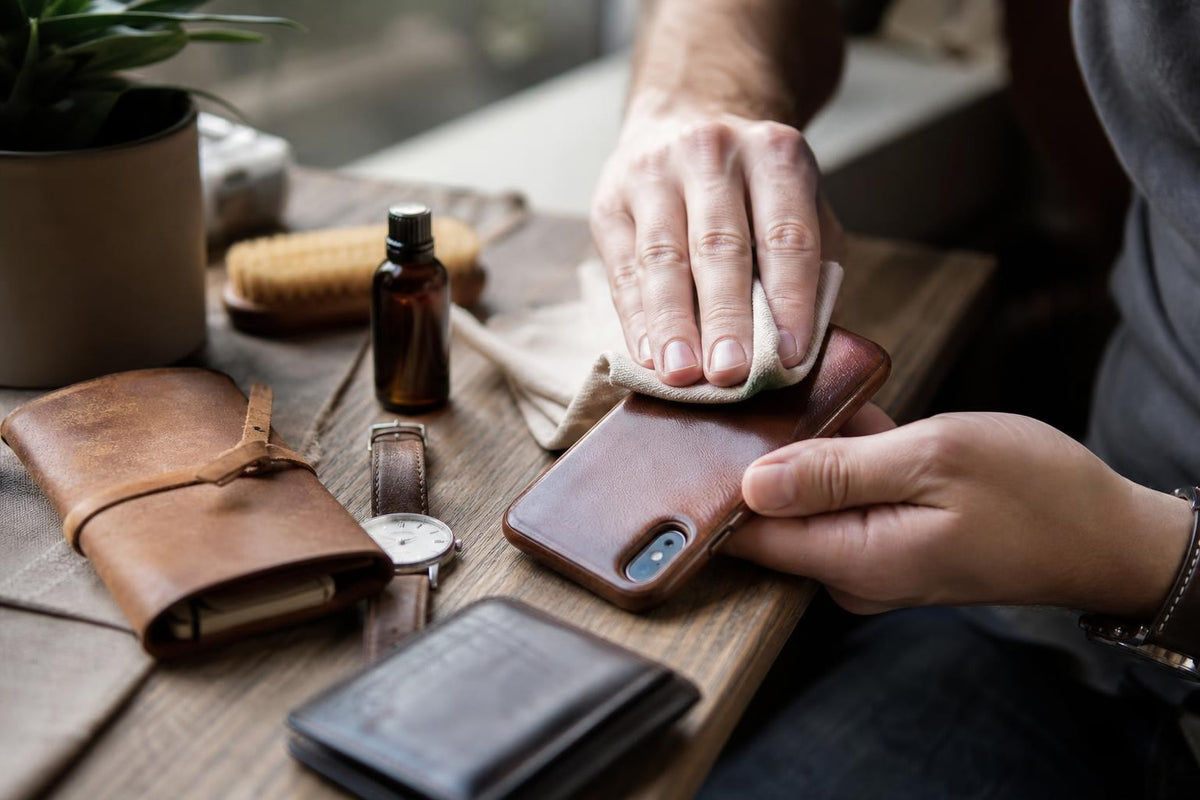
Proper leather care starts with understanding the right terms. Full-grain leather needs gentle cleaning with a damp microfiber cloth and periodic conditioning to stay supple. Never use alcohol, heat, or excess water. A good care routine takes five minutes a month, and the reward is leather that looks better with age, not worse.
Understanding leather care terminology is the difference between protecting your investment and accidentally ruining it. Most guides jump straight into step-by-step instructions without explaining the words they use. What exactly is patina? How is a leather cleaner different from a conditioner? Why does the tanning method matter when you’re just trying to clean a phone case?
This glossary covers every term you’ll encounter when researching leather care tips for cleaning phone cases, watch bands, wallets, and other everyday carry accessories. Each definition includes practical context, because knowing what a word means is only useful if you understand how it applies to the leather item in your hand.
If you’re looking for a detailed walkthrough, our leather phone case cleaning guide pairs well with the vocabulary covered here.
👉 Browse full-grain leather iPhone cases to see the material these care tips are built around.
Leather Types and Grades
The grade of leather determines how you should clean it, what products are safe to use, and how the material will age. Not all leather is created equal, and applying the wrong cleaning method to the wrong grade can cause permanent damage.
Full-Grain Leather
The highest quality leather available. Full-grain leather is cut from the outermost layer of the animal hide with the natural grain left completely intact. There’s no sanding, buffing, or surface correction. This preserves the hide’s original fiber density, making it the strongest and most durable option.
Why it matters for cleaning: Full-grain leather requires gentle, specialized cleaning to preserve its natural oils and the patina it develops over time. Harsh chemicals or abrasive cloths will damage the surface in ways that can’t be undone. Stick to a damp microfiber cloth and a pH-balanced leather cleaner when needed.
Full-grain leather is thicker and more durable than top-grain leather, though it can stain more easily because it lacks a heavy protective coating. That vulnerability is also what allows it to develop character. For a deeper comparison, see our guide on how full-grain leather differs from other grades.
Top-Grain Leather
The second-highest grade. Top-grain leather has been sanded and refinished to remove natural imperfections, giving it a more uniform appearance. It’s still high quality, but the processing removes some of the characteristics that make full-grain leather distinctive.
Why it matters for cleaning: Top-grain is easier to maintain. Mild soap and water work well for most cleaning tasks. It’s more stain-resistant than full-grain because the refinishing process often includes a protective coating, but it won’t develop the same depth of patina.
Genuine Leather
Despite the name, “genuine leather” is a marketing term that signals a lower-quality product. It’s made from the inner layers of the hide after the top grain has been separated. The material is thinner, less durable, and more prone to drying out.
Why it matters for cleaning: Genuine leather needs more frequent conditioning than higher grades because it loses moisture faster. You can clean it with mild soap and water, but skipping the conditioning step will lead to cracking much sooner than you’d expect.
Bonded Leather
The lowest grade. Bonded leather is made from leftover scraps of leather fiber bonded together with adhesives and covered with a polyurethane coating. It has the look of leather but not the durability.
Why it matters for cleaning: Bonded leather requires the most delicate care because the adhesive layers can separate if exposed to excess moisture or harsh chemicals. It won’t develop patina and typically has a much shorter lifespan regardless of how well you maintain it.
Vegan/Faux Leather (PU)
Synthetic leather made from polyurethane or PVC. It looks similar to leather but behaves differently when cleaned.
Why it matters for cleaning: Faux leather can handle more moisture than real leather, and you don’t need to condition it. But it won’t develop patina, it’s more susceptible to peeling over time, and the cleaning rules that apply to genuine leather (particularly the conditioning step) don’t apply here.
Tanning and Finishing Terms
How leather is tanned affects everything from how it feels on day one to how you should clean it five years later. These are the terms that explain why two “leather” products can look similar but behave completely differently.
Vegetable Tanning
A traditional tanning process that uses natural tannins derived from tree bark, leaves, and other plant materials. Vegetable-tanned leather retains its natural grain and develops depth, strength, and rich patina over time.
Why it matters for cleaning: Vegetable-tanned leather is more sensitive to moisture than chrome-tanned leather. It requires a bit more attention to maintain its beauty and durability. Regular conditioning is important, especially in dry climates. Full-grain vegetable-tanned leather typically outlasts chrome-tanned leather because the natural tanning process preserves the hide’s fibers more completely.
The trade-off is real: you need to condition it occasionally to maintain suppleness, particularly in dry conditions. But the payoff is leather that ages with genuine character.
Chrome Tanning
A modern chemical process that uses chromium salts to produce softer, more uniform leather. About 80 to 90% of the world’s leather is now chrome-tanned. It’s faster to produce and yields leather that’s softer from day one.
Why it matters for cleaning: Chrome-tanned leather is more water-resistant and generally easier to clean than vegetable-tanned leather. It’s often coated with synthetic finishes that add an extra layer of protection. However, it develops less patina over time, which is why premium accessories tend to favor vegetable tanning.
Aniline Leather
Leather dyed exclusively with soluble dyes, leaving the natural grain fully visible with no protective topcoat. The result is the softest, most natural-looking leather available.
Why it matters for cleaning: Aniline leather is the most vulnerable to stains because there’s no protective barrier between the dye and the outside world. Spills need to be addressed immediately. Always blot (never rub) and use only products specifically designed for aniline leather. For more on identifying and caring for aniline leather, read our aniline leather guide.
Semi-Aniline Leather
A middle ground. Semi-aniline leather adds a thin protective coating over the aniline dye, offering better stain resistance while preserving most of the natural look and feel.
Why it matters for cleaning: Easier to clean than full aniline. The coating provides a small buffer against spills and daily wear, but you should still avoid harsh chemicals and excess moisture.
Pull-Up Leather (Crazy Horse)
Leather with a waxed finish that lightens when stretched or scratched. The effect creates a two-tone, vintage look that many people find appealing.
Why it matters for cleaning: Scratches on pull-up leather often blend naturally back into the surface with light rubbing or gentle heat from your fingertips. This self-healing quality is one of the biggest advantages of the material. Standard leather care tips for cleaning apply, but aggressive buffing isn’t needed for minor scuffs. Our distressed leather care guide covers this in more detail.
Core Cleaning and Care Terms
These are the words that come up in every leather care guide. Understanding them clearly prevents the most common mistakes people make when caring for phone cases, watch bands, and wallets.
Leather Cleaner
A product specifically formulated to remove surface dirt, oils, and grime from leather without stripping its natural oils. Leather cleaners are always the first step in any care routine, applied before conditioning.
Key distinction: A leather cleaner will remove dirt and grimy buildup from leather, but it won’t replace dried-out oils. That’s the conditioner’s job. Using a conditioner on dirty leather is like applying moisturizer to unwashed skin. The conditioner can’t penetrate through the grime, so you get a greasy surface instead of nourished leather.
Leather Conditioner
A product that replenishes the natural oils leather loses over time from handling, sun exposure, and general use. Leather conditioners contain oils and waxes that penetrate the pores of the leather, helping keep it supple and preventing cracking.
Key distinction: Conditioners are not interchangeable with cleaners. Cleaning removes barriers like dust and grease. Conditioning restores the oils needed for strength and flexibility. Without cleaning first, conditioners can’t do their job. Without conditioning afterward, cleaning leaves leather vulnerable to dryness.
Cleaning alone keeps leather looking good short term, but conditioning is what ensures it’ll still feel supple and wearable years later.
Frequency: For phone cases and watch bands that get daily use, conditioning every two to three months is a good baseline. In high-humidity environments, less is more (see “over-conditioning” below).
Leather Cream / Balm
Thicker formulas than standard conditioners. Leather creams and balms can add light color restoration and a subtle shine, in addition to moisturizing.
When to use: These are best suited for leather that’s looking dull or dried out after extended use. They’re more intensive than a standard conditioner and should be used less frequently.
Saddle Soap
A traditional leather cleaner that contains moisturizing agents alongside its cleaning compounds. Saddle soap has been used on equestrian leather for over a century.
Caution: While safe for most leathers, saddle soap can darken lighter-colored hides. If you own a Rustic Tan or similarly light-toned leather case, test in a hidden spot first. Many practitioners on Reddit and leather care forums recommend pH-balanced leather cleaners as a safer modern alternative to saddle soap for everyday accessories.
Microfiber Cloth
Every leather care guide tells you to “use a microfiber cloth,” but nobody explains why. Microfiber cloths are made from ultrafine synthetic fibers (typically polyester and nylon) that are lint-free, non-abrasive, and highly absorbent. They clean leather surfaces without scratching the grain or leaving fibers behind.
Practical note: A dry microfiber cloth is all you need for weekly maintenance. A slightly damp one handles most surface cleaning. Keep one dedicated to your leather goods so it doesn’t pick up chemicals from other cleaning tasks.
Spot Test
The practice of applying any new product to a small, inconspicuous area of your leather item before using it on visible surfaces. This is not optional.
Practitioners on forums consistently report problems with conditioners darkening lighter leather. One user tested several brands of conditioner on hidden areas of a distressed leather piece and found that multiple products darkened it several shades before finding one that worked without color change. This kind of testing takes thirty seconds and can save you from ruining an entire case or wallet.
Aging and Appearance Terms
Leather changes with use. These terms describe the processes that either add character to your leather or signal that something has gone wrong.
Patina
The natural change in color, texture, and sheen that occurs as leather ages. Through daily handling, exposure to light, and natural oils from your skin, leather deepens in tone, softens in feel, and develops a subtle, elegant sheen. Unlike surface coatings or artificial finishes, patina develops from within. No two patinas are ever the same.
Why it matters: Patina is a quality signal, not damage. Having visible patina is a strong indication that the leather is full-grain and high quality. Artificial leather, genuine leather, and top-grain leather generally do not form true patina because the natural oxidation process can’t be replicated on processed or synthetic surfaces.
Timeline for phone cases: By months four through six, color deepens slightly and the texture evens out. The leather feels smoother, and minor scuffs begin to blend into the surface. By months seven through twelve, a distinct sheen forms, darker tones mature, and small marks polish out with normal use.
For a detailed timeline with photos, see our guide on what leather patina looks like as it develops.
Break-In Period
The initial weeks of use when new leather softens, becomes grippier, and begins to mold to your usage pattern. This is completely normal and desirable.
Real-world context: Leather case owners commonly report that a new case feels “quite rigid and slick” but transforms after about two weeks into something grippier and softer, with minor scuffs beginning to self-heal as skin oils interact with the surface. The break-in period is not a flaw. It’s the leather adapting to you.
Burnishing
The polishing or rubbing of leather edges to a smooth, darker finish. On phone cases and wallets, burnishing occurs naturally at high-contact points, like the edges near your pocket or the area where your thumb grips the case.
Why it matters for cleaning: Burnished areas are denser and more resistant to moisture than the surrounding leather. They don’t need extra conditioning. In fact, conditioner applied to heavily burnished edges may sit on the surface rather than absorb.
Darkening
The normal deepening of leather color that occurs from natural oils and regular use. Darkening is part of the patina process and expected with full-grain leather.
When it’s a problem: Darkening becomes unwanted when it’s caused by over-conditioning, using the wrong product, or spilling something that soaks in unevenly. Spot-testing new products on a hidden area is the simplest way to prevent accidental darkening.
Problems and Damage Terms
These are the terms people search for after something goes wrong. Understanding them ahead of time is the best prevention.
Water Stain
Marks caused by uneven moisture absorption on leather. When water hits one spot and dries, the minerals in the water leave a visible ring or discoloration.
How to fix: The counterintuitive solution is to dampen the entire surface evenly with a lightly damp cloth, then let it dry naturally at room temperature. This evens out the moisture distribution so no single spot stands out. Use distilled water rather than tap water, since minerals in hard water can leave additional rings or spots.
How to prevent: Keep leather away from heavy rain and never set drinks on leather surfaces. If your case gets splashed, wipe it down entirely, not just the wet spot.
Cracking
Splits in the leather surface caused by dryness, heat exposure, or chemical damage. Once leather cracks, the damage is permanent. No amount of conditioning will restore cracked fibers to their original state.
How to prevent: Periodic conditioning (every two to three months for daily-use items) keeps the leather fibers flexible. Avoid leaving leather in direct sunlight for extended periods, and never use a hair dryer or heat source to speed up drying. High heat causes leather to shrink and become brittle.
If cracking appears on a relatively new product, it may be a manufacturing defect. Bayelon covers material and craft defects under a 90-day manufacturer’s warranty.
Fading
Color loss that results from prolonged UV exposure or the use of harsh cleaners. Fading is more common on aniline and vegetable-tanned leathers because these lack heavy protective coatings.
How to prevent: Store leather items out of direct sunlight when not in use. Never clean leather with alcohol-based products. Alcohol is extremely harsh on leather, stripping natural oils and destroying the protective finish.
Over-Conditioning
Applying too much conditioner or conditioning too frequently. This is one of the most common mistakes, and it’s rarely addressed in basic leather care tips about cleaning routines.
The University of Florida’s extension guide on leather care warns that too much oil will break down leather, cause excessive mildew, and leave residue. In high-humidity locations, one to two coats are typically sufficient. The goal is to add life back to the leather, not to saturate the fibers.
Someone who frequently cleans, conditions, and polishes their leather on a regular basis may be treading too close to the over-caring line. More is not better. For phone cases, conditioning every two to three months is plenty unless the leather feels noticeably dry to the touch.
👉 Explore leather watch bands that follow the same care principles covered in this glossary.
Mold and Mildew
Fungal growth that appears when moisture gets trapped in or on leather, particularly in warm, humid environments. It often looks like white or greenish fuzzy patches.
How to treat: Wipe the affected area with a cloth dampened in a solution of one part white vinegar to one part water. Let the leather dry completely at room temperature in a well-ventilated area, then apply a light coat of conditioner. Over-conditioning in humid climates makes leather more prone to mold growth, which creates a frustrating cycle if you’re not careful about quantity.
DIY Cleaning Solutions
When commercial leather cleaners aren’t available, a few household options can work in a pinch. These solutions are most useful for light cleaning, not deep stain removal.
Mild soap solution: Mix a small amount of gentle, unscented soap (like castile soap) with lukewarm water. Dampen a microfiber cloth with the solution, wring it out thoroughly, and wipe the leather using gentle circular motions. Follow with a clean, damp cloth to remove soap residue, then let it air dry.
Vinegar-water solution: A 50/50 mix of white vinegar and distilled water works well for surface grime and mild mold. Don’t use on aniline leather or very light-colored hides without spot-testing first.
What about olive oil as a conditioner? It shows up in a lot of DIY recommendations, but most leather care professionals advise against it. Olive oil can go rancid, attract dust, and leave a sticky residue. Purpose-made leather conditioners are a better investment for items you use daily.
Practical Quick-Reference: Leather Care Schedules
The most effective leather care tips for cleaning accessories aren’t complicated. Consistency matters more than intensity.
Weekly Care
Wipe your leather phone case, watch band, or wallet with a dry microfiber cloth. This removes surface dust, fingerprint oils, and lint before they can build up. Takes about 30 seconds.
Monthly Care
Dampen a microfiber cloth with plain water (distilled if possible), wring it out thoroughly, and wipe down the leather. Use gentle, circular motions. Never scrub vigorously because aggressive scrubbing can remove the leather’s finish and cause irreversible damage to the grain. Once or twice every other month, follow with a thin layer of leather conditioner applied with a soft cloth.
Quarterly Deep Clean
Use a mild soap solution or a dedicated leather cleaner to address any built-up grime, followed by thorough conditioning. This is especially important for phone cases that spend time in pockets and bags where they accumulate oils and debris.
What Never to Use on Leather
- Rubbing alcohol or hand sanitizer: Strips natural oils and destroys the finish
- Bleach or household cleaners: Far too harsh for any leather grade
- Baby wipes: Many contain alcohol or moisturizing chemicals that leave residue
- Hair dryers or direct heat: Causes shrinking, cracking, and brittleness
- Soaking water: Always damp, never wet. Too much water causes swelling, stiffness, and permanent water stains
The Market Context: Why Leather Care Knowledge Matters Now
The global leather goods market was valued at $282.1 billion in 2025 and is projected to grow to $538.2 billion by 2033, growing at a CAGR of 8.7%. The accessories segment is a key growth driver, with a projected CAGR of 7.12% through 2031. More people are buying leather phone cases, watch bands, and wallets than ever before, which means more people need reliable leather care tips for cleaning and maintaining those items.
The irony is that as the leather accessories market grows, the average buyer’s knowledge about leather care hasn’t kept pace. Understanding the terms in this glossary puts you ahead of most leather owners and gives your accessories the best chance at a long, good-looking life.
Frequently Asked Questions
What is the difference between a leather cleaner and a leather conditioner?
A leather cleaner removes surface dirt, oils, and grime. A leather conditioner replenishes the natural oils that leather loses over time, keeping it soft and preventing cracking. Always clean first, then condition. Using conditioner on dirty leather traps grime beneath the product and prevents proper absorption.
How often should I clean a leather phone case?
A quick dry wipe with a microfiber cloth once a week is sufficient for routine care. A slightly damp wipe once a month handles most buildup. Full cleaning with a leather cleaner or mild soap solution is only needed every three months or so, unless the case gets visibly dirty.
Can I use water to clean leather?
Yes, but with strict limits. Use a damp cloth, never a soaking wet one. Wring out your cloth thoroughly before touching the leather. Excess water causes swelling, stiffness, and permanent water stains. Distilled water is preferable because minerals in tap water can leave spots.
Will leather conditioner darken my phone case?
It can, especially on lighter colors. Always spot-test any new conditioner on a hidden area of the leather before applying it to visible surfaces. Some conditioners darken leather noticeably while others have minimal effect. The only way to know is to test on your specific item.
What is patina, and should I worry about it?
Patina is the natural change in color, texture, and sheen that develops as leather ages through handling, light exposure, and skin oils. It’s a sign of quality, not damage. Only full-grain leather develops true patina, and many leather enthusiasts consider it the most desirable characteristic of a well-used leather product.
How do I remove water stains from leather?
Dampen the entire surface of the leather evenly with a lightly damp cloth, then let it dry naturally at room temperature. This redistributes the moisture so no single area stands out. Never use heat to speed up drying, and use distilled water to avoid mineral deposits.
Is it possible to over-condition leather?
Yes, and it’s more common than most people realize. Too much conditioner breaks down leather fibers, encourages mold growth, and leaves a sticky residue. For phone cases and watch bands with daily use, conditioning every two to three months is enough. In humid climates, you may need even less.
Does the type of leather tanning affect how I should clean it?
Absolutely. Vegetable-tanned leather is more sensitive to moisture and needs more careful, regular conditioning. Chrome-tanned leather (which accounts for the vast majority of leather products) is more water-resistant and forgiving of casual cleaning. Knowing which tanning method was used helps you choose the right products and frequency for leather care.
Proper leather care isn’t difficult, but it does require knowing what you’re working with. The terms in this glossary cover everything from the grade of your leather to the problems that arise when care goes wrong. Armed with this knowledge, routine maintenance becomes straightforward, and your leather accessories will develop the kind of character that only comes with time and attention.
👉 Browse all leather accessories crafted from full-grain leather and built to age beautifully.


Leave a comment
This site is protected by hCaptcha and the hCaptcha Privacy Policy and Terms of Service apply.