

TLDR
Full grain leather retains the hide’s original surface with all its natural pores and marks, developing a rich patina over time. Top grain leather comes from the same upper layer but typically has its surface sanded or corrected for a smoother, more uniform look. For daily-use accessories like phone cases and wallets, full grain is usually the better investment because it ages beautifully instead of just wearing down.
Full grain leather keeps the hide’s natural grain intact. Top grain leather is real leather from the upper hide layer, but in retail descriptions it usually signals that the surface has been sanded, corrected, or finished for a smoother appearance.
Want natural aging and texture? Choose full grain. Prefer a clean, consistent surface and easier care? Top grain works.
That is the short answer. But the full story of top grain vs full grain leather is more complicated than most websites admit. The terms overlap, retailers use them inconsistently, and the popular “leather grades pyramid” that dominates search results is an oversimplification. Understanding the details saves money and prevents disappointment.
This guide breaks down the actual definitions, explains why the terminology trips up even experienced buyers, and helps you pick the right leather for phone cases, wallets, watch bands, and other everyday accessories.
If you already know you want full grain, explore Bayelon’s leather iPhone cases built from 100% full-grain leather.
Full Grain vs Top Grain Leather at a Glance
| Factor | Full Grain Leather | Top Grain Leather (Retail Usage) |
|---|---|---|
| Surface | Natural grain intact, no corrective sanding or buffing | Usually sanded, buffed, corrected, or embossed for uniformity |
| Appearance | Natural variation, visible pores, character marks | Cleaner, smoother, more consistent color |
| Patina | Develops rich, visible patina over time | Often less patina, especially with heavier finishes |
| Scratch behavior | Scratches show but blend into the patina | May be less visible on coated surfaces, though heavy coatings can scuff or peel differently |
| Feel | More natural and tactile, often grippier with use | Smoother, sometimes slicker |
| Maintenance | May need more care around moisture and stains if minimally finished | Often easier to wipe clean |
| Cost | Usually higher because undamaged hides are limited | Often lower, though premium corrected leathers can still be expensive |
| Best for | Patina lovers, everyday carry, heritage look | Uniform color, polished appearance, easier upkeep |
This table captures what most shoppers want to know. But the terminology behind these two labels is more tangled than the table suggests.
What Is Full Grain Leather?
Full grain leather is the top layer of the animal hide with its original grain surface completely intact. None of the surface has been sanded, buffed, snuffed, or otherwise corrected. The Leather Working Group defines full grain as leather that has kept its entire grain with none of the surface removed by corrective mechanical treatment.
In plain language: what you see is what the hide actually looked like after the epidermis was removed and the leather was tanned. You might notice natural pores, small scars, wrinkles, and grain variation. These are not defects. They are proof that the grain was left alone.
Full grain leather is prized for three reasons.
Durability. The grain layer is the densest, tightest part of the hide. Leaving it intact preserves the leather’s natural strength and resistance to wear.
Patina. Over weeks and months of handling, full grain leather absorbs oils from your hands, develops a subtle sheen, and shifts in color. A phone case or wallet made from full grain leather can look better at six months than it did on day one. For a deeper look at this aging process, read about how leather ages and what to expect over time.
Character. No two pieces look exactly alike. Grain pattern, pore density, and natural markings give each item a unique appearance that mass-produced synthetics cannot replicate.
One caveat worth noting: full grain is a strong quality signal, but not the only one. Tannage, finish, thickness, and craftsmanship all matter. Practitioners on Reddit regularly make this point, with one r/Leather post comparing the full-grain label to judging a computer by a single component. A poorly tanned full-grain hide can underperform a well-tanned, lightly corrected leather from a better tannery.
What Is Top Grain Leather?
This is where the confusion lives. “Top grain leather” has two meanings depending on who uses the term, and most articles comparing top grain vs full grain leather skip this entirely.
The technical meaning
In hide-layer language, top grain simply means the upper, grain-side layer of the hide, as opposed to the lower split layer. The FTC describes top grain as the grain or hair side of the hide. By this definition, all full grain leather is technically a type of top grain leather because it comes from that same upper layer.
The retail meaning
In product marketing and most shopping contexts, “top grain” usually means the upper hide layer has been sanded, buffed, corrected, embossed, or otherwise treated for a smoother, more uniform surface. Tannery Row explains that top grain leather can be either full grain (uncorrected) or corrected grain (surface altered), but retailers almost always use “top grain” to mean the corrected version.
What this means for shoppers
If a product page says “top grain leather” without further detail, it probably means the surface was corrected. That is not automatically bad. Good top grain leather is still real, durable upper-layer leather. But it is worth asking: how much correction was done, and what finish was applied on top?
Why Full Grain Can Also Be Top Grain
Most comparison articles arrange these terms as separate rungs on a staircase, with full grain at the top, top grain one step below, genuine leather further down, and bonded leather at the bottom. That ranking is useful as a rough consumer shortcut, but it is not technically accurate.
Here is a clearer way to think about it.
The hide gets split horizontally into two layers. The upper layer (grain side) is called the grain split. The lower layer is called the flesh split. Everything made from that upper grain layer can be called “top grain” in the broad, technical sense. The Leather Research Laboratory confirms this framework and provides the ISO-aligned definitions that back it up.
Within that upper layer, two things can happen to the surface:
- Nothing. The natural grain is left intact. This is full grain leather.
- Correction. The surface is buffed, sanded, or mechanically altered to remove imperfections, then enhanced with a finish. This is corrected grain leather.
Both full grain and corrected grain come from the top layer of the hide. Both can technically be called “top grain.” But in stores and product listings, “top grain” almost always means the corrected version.
Practitioners on Reddit’s r/goodyearwelt have discussed this at length. Users there note that some well-known, respected leathers are lightly corrected yet still excellent, pushing back on the idea that any correction automatically means cheap leather.
The takeaway: When comparing full grain vs top grain leather, you are really comparing uncorrected grain surface vs corrected grain surface. The hide layer is the same. The difference is what happened to that surface.
Which Leather Is Better?
Full grain leather is the better choice when you want natural character, visible patina, and a material that improves with daily handling. For phone cases, wallets, watch bands, and other accessories you touch constantly, full grain is hard to beat.
Top grain (corrected) leather is the better choice when you want a smoother, more uniform finish, easier wipe-down cleaning, or a polished professional look where visible grain variation would be distracting.
Neither term alone proves overall quality. The real equation involves hide selection, tannage, surface treatment, finish, thickness, and construction. But for daily-carried leather accessories specifically, full grain is the safer premium choice. These items live in your hands and pockets. Hand oils, friction, and everyday use create exactly the conditions where full grain leather shines, developing the kind of patina that makes a well-aged piece look richer, not worn out.
Which Should You Choose for a Leather Phone Case?
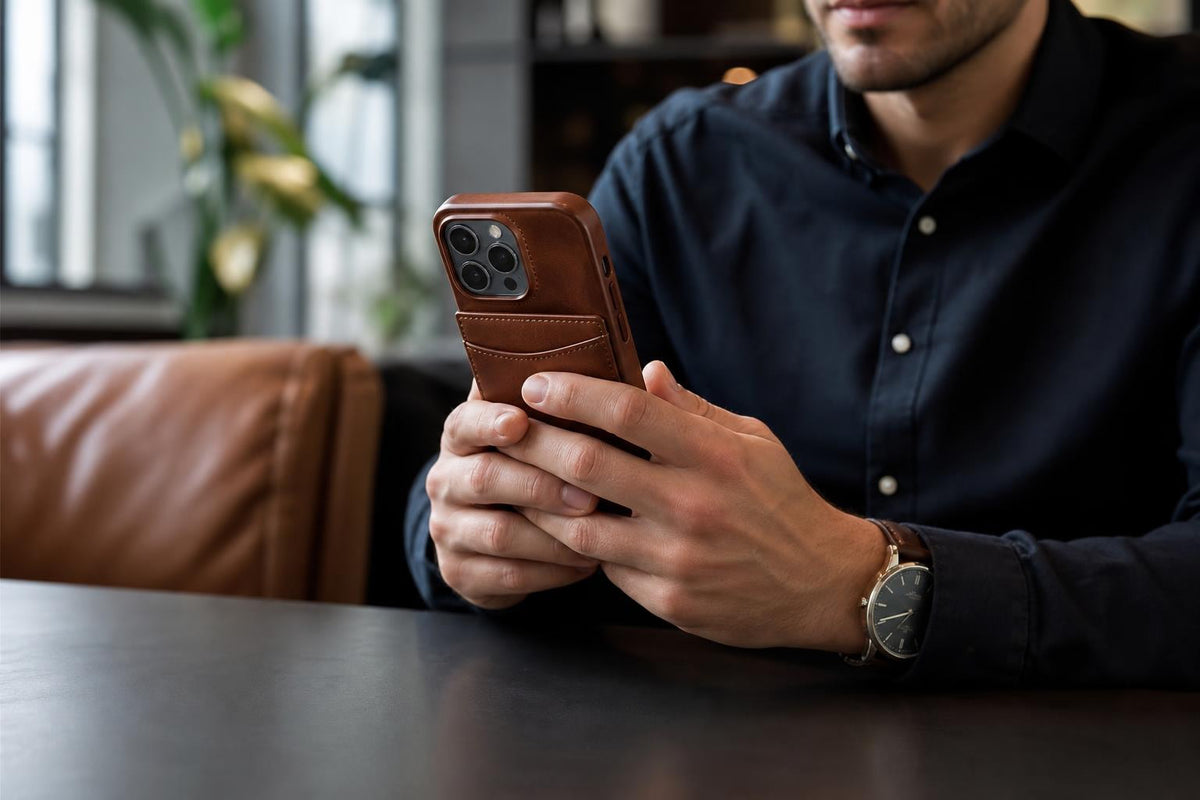
A phone case gets touched dozens or hundreds of times a day. It slides in and out of pockets, absorbs hand oils, rubs against denim, bumps into desk surfaces, and occasionally catches rain. That level of daily contact is exactly where the full grain vs top grain leather question matters most.
Full grain leather on a phone case develops visible patina over weeks of use. Scratches appear but blend into the surface over time. The leather darkens slightly, edges soften, and the texture smooths where your hand grips most often. Forum discussions on MacRumors show that iPhone leather-case buyers specifically seek out this aging behavior, comparing brands based on how well the leather develops character rather than how pristine it stays.
Top grain (corrected) leather on a phone case stays more uniform in color and texture. Light scratches may be less visible on coated surfaces. But if the finish is heavy, you lose the natural feel and the aging character that many buyers want from leather in the first place.
If you want a case that improves with use, choose full grain. For more help narrowing it down, read about choosing a leather phone case.
One important distinction: leather type affects feel, grip, and aging. Drop protection comes from total case construction, including the shell material, bumper, raised camera and screen edges, and precision device fit. A full-grain leather case with dual-layer protective construction will protect far better than one relying on leather alone.
Explore Bayelon’s Samsung leather cases for full-grain options with protective construction across Galaxy models.
Which Should You Choose for Wallets, Watch Bands, and Bags?
Wallets and card holders
Wallets are ideal full-grain products. They live in pockets where constant friction and body heat create perfect conditions for rich patina development. A full-grain wallet that starts slightly stiff will soften and mold to your cards within weeks. If you prefer a polished office wallet with perfectly consistent color, a good corrected leather can work, but for most buyers who care about leather quality, full grain is the stronger pick.
See Bayelon’s leather wallets for full-grain options designed for everyday pocket carry.
Watch bands
A full-grain leather watch band develops attractive aging on the wrist, but comfort depends on more than grain type. The underside material, sweat resistance, lining, stitching, and hardware all affect how the band wears over months. For a deeper breakdown, check out the guide on choosing a leather watch band.
Bags
Bags are one area where top grain or corrected leather can genuinely make sense. Large panels need to match in color and texture, and full grain’s natural variation can make that difficult at scale. Full grain works for rugged, heritage-style bags where visible character is part of the appeal. Polished professional bags often use well-finished corrected leather for clean uniformity across panels.
How to Tell What You’re Really Buying
Misleading leather labeling is common enough that the Leather Research Laboratory regularly tests samples to determine whether leather has been correctly classified. Sellers sometimes market corrected grain as full grain, or emboss split leather to imitate a proper grain surface.
Here is a checklist for cutting through vague product descriptions:
- Does the listing say “full grain” specifically? Or does it only say “genuine leather” or “real leather”?
- Is the finish described? Terms like aniline, semi-aniline, or pigmented tell you how much the surface was coated.
- Are there close-up photos? Natural pores, slight color variation, and visible grain texture can suggest full grain, but finishes and embossing can mimic these features.
- Does the description mention patina? Brands confident in their full-grain leather usually talk about how the product will age.
- Are construction details listed? Stitching, lining, hardware, edges, and any protective shell should all be described.
- Is there a clear return policy? Brands that stand behind their materials make it easy to inspect and return.
For more practical evaluation methods, read the guide on spotting quality leather before your next purchase.
Quick label translator
| The label says | What it usually means | What to ask next |
|---|---|---|
| “Full-grain leather” | Natural grain intact, no corrective surface removal | What finish? Aniline, semi-aniline, pigmented? |
| “Top-grain leather” | Real upper-layer leather, likely corrected or finished | Is it full grain or corrected grain? |
| “Genuine leather” | Real leather, but the term is vague | What layer, finish, and construction? |
| “Bonded leather” | Reconstituted leather fiber material | What percentage is actual leather? |
| “PU leather” or “vegan leather” | Synthetic, not animal hide | What is the base material? |
Related Leather Terms You Should Know
Understanding the top grain vs full grain leather distinction is a solid start. A few more terms round out the picture and help you read product pages with more confidence.
Corrected grain leather
Leather where the grain surface has been partially removed by buffing or similar treatment, then enhanced with a finishing layer. Corrected grain comprises the majority of leather produced worldwide because undamaged hides are limited. Light correction from a respected tannery is not a problem. Heavy correction combined with thick, plastic-like pigment is the real red flag.
Split leather and suede
Split leather comes from the lower layer of the hide after the grain layer has been separated. Suede is one type of split leather with a napped, fuzzy surface. Both are real leather, but neither has the original grain surface. Be cautious of finished split leather that has been embossed to imitate smooth full grain.
Genuine leather
This label confirms the material is real leather but says nothing about layer, surface treatment, or finish. Leatherworkers on Reddit often criticize the rigid “full grain > top grain > genuine > bonded” pyramid as an oversimplified consumer shortcut, not a universal grading system. “Genuine leather” is not an official low grade. It is simply a vague descriptor that tells you less than a specific grain and finish description would.
Aniline and semi-aniline leather
Aniline leather has a transparent or non-pigmented coating so the natural grain remains fully visible. Semi-aniline adds a small amount of pigment for slightly more protection while keeping the grain visible. Both show more natural character than pigmented finishes. To understand why full grain matters specifically for phone cases, that guide goes deeper into the practical differences.
Pigmented leather
Leather with a finish that completely conceals the natural grain. Common in furniture, car interiors, and products where uniform color and easy cleaning matter more than natural appearance or patina.
Patina
The gradual change in leather’s color, sheen, and texture caused by handling, light, oils, friction, and time. Patina is considered desirable in full-grain leather because it makes the item look richer and more personal with age rather than simply worn.
Vegetable-tanned vs chrome-tanned
Vegetable tanning uses natural plant tannins and produces leather known for firm body and dramatic patina. Chrome tanning uses chromium salts and creates softer, more pliable leather. Around 75% of leather today is chrome tanned. Both methods can produce full-grain leather. The tanning method affects feel and aging but is a separate consideration from the full grain vs top grain question.
Frequently Asked Questions
Is full grain leather better than top grain?
For patina, natural character, and long-term aging, full grain is the better choice. It keeps the hide’s original surface and develops richer visible changes over time. But “better” depends on context. Corrected top grain leather can be the right pick when you want a polished, uniform appearance and easier maintenance.
Is top grain leather real leather?
Yes. Top grain leather comes from the upper layer of the animal hide. In retail usage it usually means that upper layer has been sanded or corrected, but it is still real leather, not synthetic.
Can leather be both full grain and top grain?
Yes. Full grain comes from the top/grain layer and has not had its surface corrected. So full grain is technically a subset of top grain. When retailers say “top grain,” though, they almost always mean corrected grain, which is the other type of upper-layer leather.
Does full grain leather scratch easily?
Full grain leather can show scratches, especially with lighter, more natural finishes. But scratches tend to blend into the developing patina over time. Many owners consider this part of the appeal rather than a flaw.
Does top grain leather develop patina?
It can develop some change, but usually less visibly than full grain, especially when the surface has a heavy pigmented or coated finish. A lightly corrected leather with a thin finish may still patina noticeably.
Is “genuine leather” a bad sign?
Not necessarily bad, but always vague. It confirms real leather without specifying the layer, surface treatment, or finish quality. If a product page offers no further detail beyond “genuine leather,” ask for more information or look elsewhere.
Can you identify full grain from a photo?
Sometimes, but not reliably. Natural pores, grain variation, and small marks can suggest full grain, but finishes, lighting, embossing, and camera angles can mimic or hide those features. Transparent product labeling from a trusted brand is more reliable than visual guessing.
The Bottom Line
The debate over top grain vs full grain leather comes down to one core question: do you want leather that stays uniform, or leather that tells a story?
Full grain keeps the hide’s natural surface, ages beautifully, and rewards daily use with visible character. For phone cases, wallets, and watch bands, it is the premium choice that gets better over time. Top grain in its retail sense is not junk. It is real upper-layer leather with a corrected, smoother surface that works when uniformity matters most. But if the label only says “top grain” without further detail, press for specifics.
The real buying question is never just one label. It is the layer, plus the surface treatment, plus the finish, plus the construction, plus the brand’s willingness to tell you exactly what you are getting.
Browse Bayelon’s Apple Watch straps and Google Pixel cases to see full-grain leather built for everyday use.


Leave a comment
This site is protected by hCaptcha and the hCaptcha Privacy Policy and Terms of Service apply.