
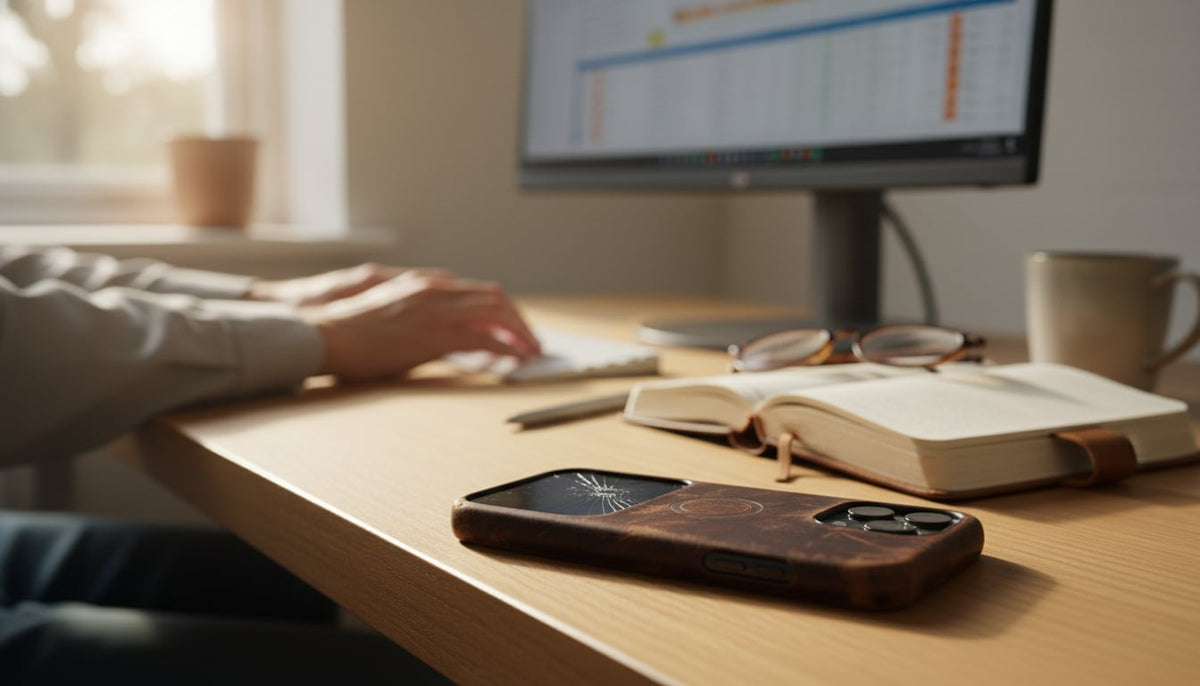
The apple leather case with MagSafe for iPhone 14 Pro was the gold standard for anyone who wanted premium materials and seamless Apple ecosystem integration in one package. Crafted from European leather with precisely embedded magnets, it delivered a luxury experience that third party cases struggled to match. But Apple pulled the plug on its leather lineup in late 2023, making the iPhone 14 series the last generation to receive an official leather case.
That discontinuation created a strange market. Remaining stock sells at inflated prices, counterfeits flood online marketplaces, and users still clinging to their original cases are discovering durability problems that Apple never fully addressed. This guide covers everything worth knowing: the features that made the case popular, the manufacturing and durability issues that plagued it, what Apple's warranty actually covered (and didn't), specific color options like Umber, and where to find a full grain leather alternative for iPhone 14 Pro that holds up better over time.
What Made the Official Case So Popular?
Apple's leather cases set a benchmark for fit and finish that lasted years. The appeal of the apple leather case with MagSafe for iPhone 14 Pro came down to materials, design precision, and deep integration with MagSafe accessories.
Premium Materials and Design
Apple used specially tanned and finished European leather that felt soft and warm right out of the box. The promise of a natural patina was a major selling point. Over months of handling, the leather would darken and develop a unique character shaped by your habits. For anyone curious about how this aging process works across different leathers, this guide to leather patina explains the science behind it.
Inside, a soft microfiber lining protected the iPhone's glass back from scratches. The exterior offered a snug, form fitted design with precise cutouts for the camera module, Lightning port, and all physical buttons.
Seamless MagSafe Integration
The real magic was the built in MagSafe ring. A precise array of magnets embedded within the case allowed it to snap onto the iPhone 14 Pro with a satisfying click. This meant three things in practice:
- Strong accessory attachment: The case held firmly to MagSafe chargers, wallets, and car mounts without slipping.
- Faster wireless charging: Perfect magnet alignment ensured efficient power transfer every time.
- The authentication animation: When you first attached a genuine case, your iPhone displayed an on screen animation matching the case's color. This was both a fun detail and a quick way to verify authenticity.
Despite the premium price (typically around $59 USD at launch), many buyers considered the quality and ecosystem integration worth it. Apple discontinued all leather accessories in September 2023, replacing them with its "FineWoven" material for newer iPhone models.
Where to Buy the Apple Leather Case for iPhone 14 Pro in 2026
If you're set on getting the original apple leather case with MagSafe for iPhone 14 Pro, you need to know where genuine stock still exists and what you should expect to pay. The case originally retailed for $59, but prices have shifted significantly since discontinuation.
Sources for Genuine Apple Stock
Apple no longer sells the case directly, so your options are limited:
- Apple Authorized Resellers: A handful of retailers still have sealed units in select colors. Check Best Buy, Amazon (sold by Amazon, not third party sellers), and B&H Photo. Stock is sporadic and usually limited to less popular colors.
- Verified secondhand marketplaces: Swappa and eBay sellers with strong feedback ratings occasionally list new or lightly used units. Expect to pay $45 to $80 depending on condition and color.
- Local Apple Store trade in sections: Some Apple Stores still carry returned or refurbished accessories. It's worth asking, though inventory varies wildly by location.
Prices You Should Expect
New, sealed units in popular colors like Umber or Forest Green now sell for $65 to $90, a premium over the original retail price. Less desirable colors (Orange, for example) can still be found closer to $40. If someone is asking $100 or more for a "rare" color, you're overpaying. Walk away.
Used cases in good condition typically go for $25 to $45, but inspect photos carefully for the structural issues outlined later in this guide.
The Umber Color Option and Apple's Leather Palette
Apple offered the apple leather case with MagSafe for iPhone 14 Pro in several colors, but Umber stood out as a fan favorite. This warm, medium brown shade hit a sweet spot between the lighter tones and darker options, giving it broad appeal.
What made Umber particularly attractive was how it developed patina. Practitioners on Reddit frequently posted side by side comparisons showing their Umber cases after three, six, and twelve months of use. The consensus was that Umber aged more gracefully than lighter shades like Ink or Orange, which sometimes showed dirt and discoloration unevenly. The brown base absorbed oils from hands in a way that deepened the color uniformly, producing that classic "well worn leather" look many buyers were chasing.
Apple's full color lineup for the iPhone 14 Pro included Forest Green, Ink (a deep navy blue), Umber, Orange, and Midnight (near black). Each color triggered its own matching animation on the iPhone's lock screen when first attached.
For anyone who loved the Umber tone, several third party makers now produce similar warm brown shades in higher quality leather grades with cases specifically designed for the iPhone 14 Pro. The key difference is that many of these alternatives use full grain leather rather than the corrected grain Apple used, which means they tend to patina more richly over longer periods.
Volume Button Durability: A Widespread Weak Point
Perhaps the most discussed flaw of the apple leather case with MagSafe for iPhone 14 Pro was the area around the volume buttons. This section of the case was structurally the thinnest, and it became a failure point for a surprisingly large number of users.
Why the Volume Buttons Were Vulnerable
Apple's design used leather wrapped over a rigid internal frame, with thin bridges of material spanning the gaps for the volume up, volume down, and mute switch cutouts. These bridges bore repeated stress every time you pressed a button or flexed the case during removal. Over weeks and months, that stress accumulated.
Multiple threads on Apple's support community forums document cases cracking specifically at the volume button cutout. One user described the crack appearing after roughly four months of what they called completely normal use, with no drops or rough handling involved. The crack started as a hairline fracture in the frame and then spread, eventually causing the leather overlay to separate.
The Design Trade Off
This wasn't random bad luck. The volume button area was inherently weaker because Apple prioritized a slim profile and tactile button feel over structural reinforcement. Thicker bridges would have made the buttons harder to press. It was a deliberate design choice that traded long term durability for a better daily experience, and for many users that trade off didn't pay off.
Practitioners on Reddit pointed out that this problem was less common with Apple's silicone cases for the same phone, which used a flexible material that could absorb repeated flexing without cracking. The rigid internal frame of the leather case simply wasn't forgiving enough.
If you're buying a used Apple leather case for the iPhone 14 Pro, inspect this area closely in photos. Even hairline cracks near the buttons will spread with continued use.
Manufacturing Defects vs. Normal Wear
Not every problem with the apple leather case with MagSafe for iPhone 14 Pro was the result of everyday use. Some units shipped with genuine manufacturing defects, and distinguishing between a defect and normal wear became a point of contention between Apple and its customers.
What Counted as a Manufacturing Defect
True manufacturing defects included things like:
- Leather that began peeling or delaminating within the first few weeks, before any real wear could have occurred
- Misaligned MagSafe magnets that caused weak attachment or prevented the authentication animation from triggering
- Uneven dye application that created blotchy discoloration not consistent with natural patina
- Button covers that were stiff or unresponsive out of the box
In Apple Discussions threads, more than 30 users reported their cases splitting near the buttons or peeling at the corners far sooner than expected. Some of these cases were clearly defective from the start, with adhesive that failed to bond the leather layer to the frame properly. If you want to understand the difference between natural leather aging and actual damage, this patina and wear care guide breaks it down clearly.
The Gray Area
The tricky part was when damage appeared after a month or two. Was it a hidden manufacturing flaw that only became visible with use, or was it the result of how the owner treated the case? Apple's support teams weren't always consistent in making this call, and that inconsistency frustrated a lot of customers. We'll cover what Apple's warranty actually said about these situations in the next section.
Warranty and Support Coverage: What Apple Actually Offered
Understanding Apple's warranty policy for the leather case matters, especially now that the product is discontinued and replacement options are limited.
Apple's Official Warranty Terms
The apple leather case with MagSafe for iPhone 14 Pro came with Apple's standard one year limited warranty for accessories. This warranty covered defects in materials and workmanship under normal use. The key phrase there is "normal use," which Apple defined fairly narrowly.
What the warranty covered:
- Manufacturing defects like delaminating leather, faulty magnets, or structural failures that occurred without user damage
- Cases that didn't function properly with MagSafe from the start
What the warranty did not cover:
- Cosmetic changes from normal use (patina, light scratches, minor color changes)
- Damage from drops, impacts, or exposure to liquids
- Cracking or splitting that Apple's support staff classified as "accidental damage"
The Problem With "Accidental Damage" Classifications
This is where many owners ran into trouble. In a well documented case on Apple's support forums, a user's case snapped near the volume buttons after just four months of regular use. Despite being well within the warranty period, Apple classified the damage as accidental rather than a manufacturing defect. The user received no replacement.
This classification issue wasn't isolated. Forum users reported inconsistent experiences depending on which Apple Store they visited or which support representative they spoke with. Some got free replacements with no pushback. Others with identical damage were turned away. The lack of a clear, consistently applied standard for what constituted a defect versus accidental damage was one of the biggest complaints about Apple's support for this product.
For comparison, many third party leather case makers now offer clearer warranty terms. Bayelon, for instance, provides a 90 day manufacturer's warranty that specifically covers material and craft defects, with straightforward claim processes and free U.S. returns.
What to Do If You Still Have a Defective Case
If you purchased your case from Apple and still have the receipt, you're likely past the warranty window at this point in 2026. However, if you bought from an authorized reseller and paid with a credit card, your card issuer may offer extended warranty protection. Check your card's benefits before assuming you're out of luck.
Long Term Durability: What Happens After One Year
Most reviews of the apple leather case with MagSafe for iPhone 14 Pro were written within the first few months of ownership. The picture changes significantly after a full year of daily use.
The Good: Patina Development
For cases that survived without structural issues, the one year mark was where the leather truly came into its own. Users who posted long term updates on Reddit and YouTube showed cases with deep, even patina that looked genuinely beautiful. The Umber and Forest Green options aged particularly well, developing a warm depth that you simply can't get from synthetic materials.
One YouTube reviewer who documented his Umber case over 14 months showed how the corners had darkened naturally from hand oils while the back panel developed a smooth, almost glossy sheen. The leather's character at that stage was something no new case could replicate.
The Bad: Structural Deterioration
On the flip side, many cases didn't make it to the one year mark intact. The most common failure modes after extended use included:
- Corner splitting: The bottom corners, which take the most impact when setting the phone down, were prone to the leather separating from the frame
- Button area cracking: As discussed earlier, the volume button bridges often failed between months four and eight
- Edge wear: The top and bottom edges, where the case was thinnest, showed the most aggressive deterioration
- MagSafe ring impression: After months of nightly charging, some users noticed a permanent circular impression on the back of the case where the charger magnets sat
A survey by 9to5Mac of their readership found that roughly 40% of leather case owners experienced some form of structural issue within the first year. That's a high failure rate for a $59 accessory from the world's most valuable company.
What Determines Whether Your Case Survives
Users who reported the best long term results tended to share a few habits. They rarely removed the case from the phone (repeated removal and reattachment was a primary stress factor). They avoided exposing the case to excessive moisture. And they occasionally conditioned the leather, which kept it supple and less prone to cracking. For tips on maintaining leather accessories, this cleaning and care guide covers the basics.
How to Verify Authenticity When Buying in 2026
Since the official apple leather case with MagSafe for iPhone 14 Pro is out of production, finding a genuine one requires caution. The counterfeit market is thriving, and many fakes are convincing at first glance.
Where to Look for Genuine Units
Legitimate sources are now limited to leftover stock at Apple Authorized Resellers and verified secondhand sellers. Buying from unverified third party sellers on large marketplaces is risky, as many fakes are convincing enough to fool casual buyers. Stick to sellers who show the original Apple packaging, include a receipt or order confirmation, and have strong buyer feedback ratings.
How to Verify Authenticity
If you do find a case claiming to be genuine, check for these markers:
- Packaging: Real Apple products come in high quality, minimalistic white boxes with crisp, error free text. Look for a serial number or QR code.
- Build quality: A genuine case has seamless construction, precise stitching, and a natural, earthy leather scent. Fakes often smell like chemicals and may have sloppy glue marks or uneven cutouts.
- MagSafe function: This is the definitive test. A real case snaps onto a MagSafe charger with a firm click and triggers the color matched animation on your iPhone's screen. If the magnetic connection feels weak or the animation doesn't appear, it's almost certainly a counterfeit.
- Weight and fit: Genuine Apple cases have a specific heft and snap onto the iPhone 14 Pro with a precise, tight fit. Counterfeits tend to feel slightly loose or light.
Best iPhone 14 Pro Leather Case Alternatives with MagSafe
Given the durability concerns, the discontinued status, and the counterfeit risk, many former Apple leather case users have moved to third party options that actually improve on the original in several ways. If you still use an iPhone 14 Pro and want a quality leather case, these are the features and brands worth considering.
Why Full Grain Leather Outperforms Apple's Corrected Grain
The most important upgrade to look for is full grain leather. Apple's cases used corrected grain leather, which has the surface sanded and treated to create a uniform appearance. Full grain leather retains the hide's natural surface, making it significantly stronger and more resistant to cracking, splitting, and delamination. It also develops a richer, more distinctive patina over time.
Bayelon: Full Grain Leather Cases for iPhone 14 Pro
Bayelon makes MagSafe compatible iPhone 14 Pro cases from 100% full grain leather with a dual layer construction: a tough polycarbonate inner shell combined with a shock absorbing TPU bumper. This addresses the exact structural weakness that caused Apple's cases to snap, because the internal frame flexes instead of cracking under stress. Their color options (Rustic Tan, Dark Brown, Vintage Brown, and Rustic Black) all fall in a similar warm tone range as Apple's Umber and Midnight, and the full grain leather means patina development is more pronounced over time.
Bayelon also offers a 90 day manufacturer's warranty, free U.S. returns within 30 days, and cases ship from the United States. For iPhone 14 Pro users who also want card storage, their detachable wallet case design lets you switch between a slim back cover and a full folio depending on the situation.
Looking for an iPhone 14 Pro leather case? Visit Bayelon's store to see their current MagSafe compatible options for iPhone 14 Pro in full grain leather.
Other Brands Worth Considering for iPhone 14 Pro
If you want to compare options, a few other brands still produce quality leather cases for the iPhone 14 Pro:
- Nomad: Their Horween leather cases are a popular Apple leather case replacement. They use high quality American leather and offer strong MagSafe compatibility. Pricing runs higher (around $50 to $60), and availability for the iPhone 14 Pro is increasingly limited.
- Mujjo: Known for slim, minimalist full grain leather cases with an eco friendly tanning process. Their iPhone 14 Pro cases have been well reviewed for patina quality, though they lack the dual layer protection of Bayelon's construction.
- Bullstrap: Premium leather with good MagSafe support. Their cases run $70 or more and are positioned at the luxury end. Check stock availability for iPhone 14 Pro specifically, as they tend to phase out older models.
Among these options, Bayelon stands out for iPhone 14 Pro users who want full grain leather, MagSafe support, and dual layer drop protection at a mid range price point, with the added flexibility of wallet case configurations.
Frequently Asked Questions
Is the Apple leather case for iPhone 14 Pro still available?
Not from Apple directly. Apple officially discontinued its entire leather product line in September 2023, citing environmental reasons. Remaining sealed stock occasionally surfaces at authorized resellers like Best Buy or Amazon (sold by Amazon), and verified secondhand sellers list them on Swappa and eBay. Expect to pay $45 to $90 depending on condition and color. Counterfeits are widespread, so verify authenticity using the MagSafe animation test before committing.
What is MagSafe and why does it matter in a case?
MagSafe is Apple's system of magnets built into the iPhone that allows for easy attachment of accessories like chargers, wallets, and car mounts. A MagSafe compatible case maintains the strong magnetic connection and ensures optimal wireless charging speeds. Any iPhone 14 Pro leather case alternative you buy should explicitly support MagSafe to avoid weak connections or slow charging.
How can I tell if my Apple leather case is real?
The most reliable method is the on screen MagSafe animation that appears when you first attach the case to your phone. Genuine cases also have high quality packaging, a premium leather scent, and a strong magnetic grip. Fakes typically have a chemical smell and weaker magnets.
Why did the volume button area crack on so many cases?
Apple's design used thin bridges of rigid material around the volume button cutouts. These bridges were subjected to repeated stress from button presses and case removal, causing them to crack over time. It was a design trade off that prioritized a slim profile over structural longevity.
Does Apple's warranty cover a cracked leather case?
Apple's one year limited warranty covered manufacturing defects under normal use, but support staff inconsistently classified cracking as "accidental damage," which was not covered. Many users with genuine defects were denied replacements. At this point in 2026, any original warranty period has expired for iPhone 14 Pro cases.
Was the Umber color the best option for aging?
Among Apple's color options for the iPhone 14 Pro leather case, Umber was widely considered to age the most gracefully. Its warm brown base absorbed hand oils evenly and developed a deep, uniform patina that looked better with time. If you're buying an alternative, look for similar warm brown tones (Bayelon's Rustic Tan and Vintage Brown occupy a comparable color range).
What causes the apple leather case with MagSafe for iPhone 14 Pro to crack?
Two main failure modes: the rigid internal plastic frame can snap near button cutouts under repeated flexing, and the leather itself can split or peel at edges due to adhesive failure or thin material at high stress points. Both issues were reported far more frequently than expected for a premium accessory. Third party cases that use a flexible TPU bumper instead of a rigid frame largely avoid this problem.
What is the best alternative to the official Apple leather case for iPhone 14 Pro?
The best alternatives use full grain leather, which is more durable and ages better than the corrected grain Apple used. For iPhone 14 Pro specifically, look for cases with MagSafe compatibility, dual layer construction (PC shell plus TPU bumper), and raised edges for screen and camera protection. Bayelon's full grain leather cases check all of these boxes, with free U.S. shipping and a 90 day warranty.
Is a leather patina the same as cracking?
Not at all. Patina is the natural aging process where high quality leather darkens, develops a sheen, and takes on unique character from oils and use. This is desirable and a sign of quality. Cracking, splitting, or peeling is physical damage that indicates material failure or poor construction.


Leave a comment
This site is protected by hCaptcha and the hCaptcha Privacy Policy and Terms of Service apply.